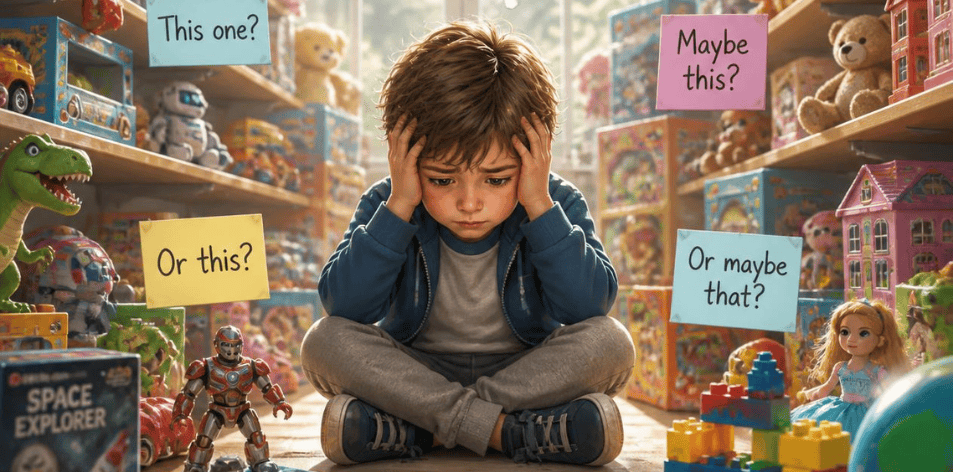
Freedom Without Guidance Creates Confusion, Not Confidence
We often assume that giving children more choices automatically makes them more independent.
What should they wear? What should they eat? Which activity would they like? Which toy should they have? Which programme should they watch?
While giving children age-appropriate choices can help them develop confidence and independence, too many choices can have the opposite effect. Instead of feeling empowered, children may become overwhelmed, anxious or constantly dissatisfied with what they have chosen.
In a world where children are surrounded by endless options, learning how to make sensible choices—and being comfortable with having fewer of them—is becoming an increasingly important life skill.
When Choice Becomes Overwhelming
A small number of choices can be helpful. A child might be asked whether they would like the blue shirt or the green one. But when they are presented with ten shirts, several breakfast options, numerous activities and unlimited entertainment, decision-making becomes considerably harder.
Children are still developing their ability to evaluate options, anticipate consequences and understand priorities.
Too many choices can therefore lead to:
✔️ Indecision
✔️ Frustration
✔️ Anxiety
✔️ Constantly changing their minds
✔️ Dissatisfaction with their decisions
✔️ Difficulty appreciating what they already have
Sometimes, more freedom does not create more confidence—it creates more pressure.
Understanding Decision Fatigue
Every decision requires mental energy.
For children, repeatedly deciding what to eat, watch, play with or buy can become exhausting. Eventually, they may become irritable, indecisive or simply expect an adult to make every decision for them.
This is one reason predictable routines can be so valuable.
When certain parts of the day are already structured—such as bedtime, mealtimes, homework or Salah—children do not need to negotiate every detail.
They can simply follow the routine.
The Role of Parental Guidance
Giving children choices does not mean parents should step completely aside.
Children still need guidance.
Instead of asking, “What do you want to do today?” a parent might say:
“Would you like to read your book first or finish your homework first?”
Both options provide some independence, but the parent has established reasonable boundaries.
As children grow older, those boundaries can gradually expand.
This teaches an important lesson: independence does not mean having unlimited choices; it means learning how to make good choices within appropriate boundaries.
Why Structure Creates Security
Children often feel more secure when they understand what is expected of them.
Consistent routines around sleeping, studying, eating, screen use, play and family responsibilities provide a sense of predictability.
Structure does not have to mean rigidity.
There should still be room for fun, spontaneity and creativity. The purpose is simply to give children a framework within which they can explore safely.
Think of it as giving a child a garden in which to play rather than asking them to wander through an endless field with no direction.
Teach Children That “No” Is Sometimes Good for Them
One of the most important lessons parents can teach is that wanting something does not automatically mean receiving it.
Children may ask for another toy, another snack, another game or more screen time.
Sometimes the answer should simply be no.
This is not about being unnecessarily strict. It is about teaching children that limits are part of life.
Learning to accept “not today” or “you already have enough” helps children develop patience, self-control and emotional resilience.
Moving From Wanting to Appreciating
Constant exposure to new products, entertainment and experiences can create the feeling that there is always something better just around the corner.
A child may receive a new toy today and already want another tomorrow.
Parents can gently counter this by encouraging gratitude and contentment.
Simple habits can help:
✔️ Encourage children to appreciate what they already own
✔️ Teach them to care for their belongings
✔️ Avoid replacing things simply because something newer appears
✔️ Encourage saving towards something meaningful
✔️ Talk about the difference between wanting and needing
✔️ Encourage gratitude for everyday blessings
For Muslim families, this can naturally connect with the Islamic value of shukr (gratitude). Children can be taught that having more is not necessarily the same as having more happiness.
Let Children Experience Natural Consequences
Guidance does not mean making every decision for a child.
Children also need opportunities to make reasonable mistakes.
If a child spends all their pocket money immediately, for example, allowing them to experience having nothing left can teach a stronger lesson than simply warning them repeatedly.
Age-appropriate consequences help children understand that choices have outcomes.
The aim is not to shame them for making mistakes, but to help them learn from them.
Don’t Confuse Freedom With Unlimited Access
Modern parenting can sometimes place pressure on parents to give children everything they want in the name of happiness or independence.
But children do not need unlimited access to everything.
They need boundaries, guidance, responsibility and gradually increasing independence.
A child who knows that there are limits can actually feel more secure because they are not expected to navigate every decision alone.
Teaching Contentment in a Consumer-Driven World
Children are constantly exposed to messages encouraging them to want more.
More toys.
More clothes.
More games.
More experiences.
More followers.
More screens.
Parents cannot remove every such influence, but they can teach children to question it.
Ask them:
“Do you really need this?”
“Will this still matter to you next month?”
“What do you already have that you enjoy?”
These conversations encourage children to think rather than simply consume.
Freedom Within Boundaries
The goal is not to raise children who are afraid to make decisions.
It is to raise children who can make decisions wisely, calmly and responsibly.
Give them choices where appropriate. Provide clear boundaries where necessary. Explain the reasoning behind important limits. Allow them to make mistakes when the consequences are manageable.
Most importantly, teach them that happiness does not come from having every option available.
Sometimes, knowing what not to choose is just as valuable as knowing what to choose.
Children need freedom, but they also need direction.
Too many choices can create anxiety, indecision and dissatisfaction, while thoughtful structure can provide the security children need to develop genuine confidence.
When parents guide rather than control, limit without unnecessarily restricting, and teach gratitude alongside independence, children gradually learn to navigate the world with greater wisdom.
True confidence does not come from having unlimited choices. It comes from knowing how to make good choices—and being content with them.