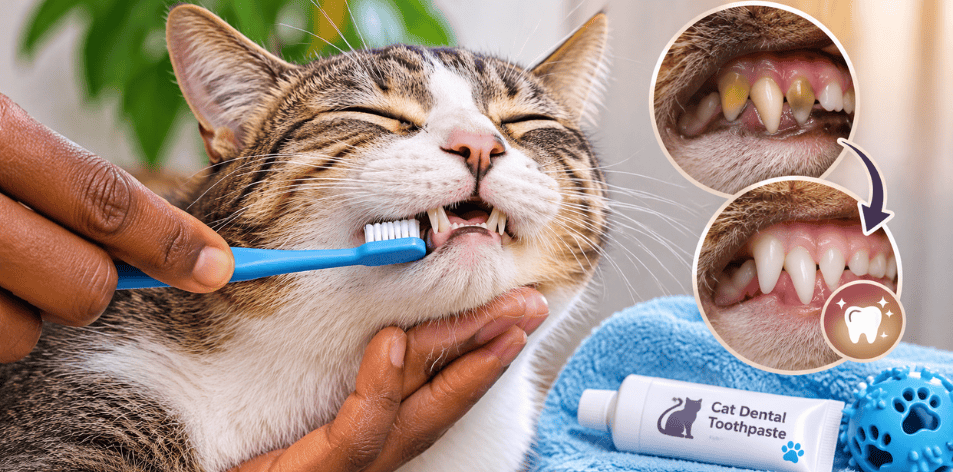
Why Does My Cat’s Breath Stink? Causes, Dental Problems & 7 Ways to Keep Your Cat’s Breath Fresh
You lean in to give your beloved feline companion a little kiss, only to be greeted by an unpleasant smell that makes you quickly turn your face away. Your cat may look perfectly healthy, eat normally and spend hours grooming itself, but that breath tells a different story!
So, why does your cat’s breath stink? Is it something your cat has eaten, poor dental hygiene or a sign that something is wrong with its health?
Here is something every cat owner should know: persistent bad breath in cats is not normal and should never simply be dismissed as part of being a cat. Although certain foods can temporarily affect the smell of your cat’s breath, an ongoing unpleasant odour may indicate plaque, tartar, gum disease or another underlying health problem. [1]
The good news is that there are practical ways to protect your cat’s oral health, prevent plaque from accumulating and recognise when professional veterinary attention is needed.
1. Why Does My Cat’s Breath Stink in the First Place?
One of the most common causes of bad breath in cats is dental disease.
Just like humans, cats develop plaque on their teeth. Plaque is a sticky film containing bacteria that accumulates on the tooth surface. If it is not regularly removed, it can harden into tartar, which irritates the gums and contributes to inflammation and infection.
This can eventually develop into periodontal disease, a condition affecting the tissues that support the teeth.
As bacteria multiply and damaged tissue develops, unpleasant-smelling compounds can cause that unmistakable foul breath.
Unfortunately, cats are very good at hiding discomfort. Your cat may continue eating and behaving normally even when its mouth is painful.
The takeaway: If your cat regularly has foul-smelling breath, do not assume it is simply because of its diet. Arrange a veterinary examination to establish the cause. [2]
2. Seven Common Reasons Your Cat May Have Bad Breath
1. Plaque and Tartar Build-Up
This is one of the most common reasons behind unpleasant cat breath.
Food particles and bacteria accumulate on the teeth, forming plaque. Over time, plaque can harden into tartar, which may appear as yellowish or brown deposits around the teeth, particularly near the gumline.
As the build-up progresses, the gums can become inflamed, creating an environment where harmful bacteria thrive.
You may notice yellow or brown teeth, red gums or a persistent unpleasant smell.
Regular dental care can help reduce plaque accumulation, but established tartar generally requires professional attention from a veterinarian.
2. Gingivitis and Periodontal Disease
Have you noticed that your cat’s gums look red, swollen or irritated?
It could be gingivitis, which is inflammation of the gums. It is commonly associated with plaque and bacterial accumulation.
If left untreated, inflammation can progress to periodontitis, which affects the structures supporting the teeth and may eventually lead to tooth loss.
Other signs can include drooling, difficulty chewing, pawing at the mouth, reduced appetite and becoming unusually irritable.
Remember, a cat does not have to stop eating for dental disease to be present. Cats can continue eating despite significant oral discomfort.
If you notice these signs, arrange a veterinary examination rather than waiting for the condition to become more obvious. [3]
3. Something May Be Stuck in Your Cat’s Mouth
Sometimes the explanation is not dental disease but something trapped in or around the mouth.
Food particles, plant material or other foreign objects may become lodged between the teeth or under the gums, creating irritation and an unpleasant smell.
You may notice your cat repeatedly pawing at its mouth, drooling, chewing differently or refusing certain foods.
Never attempt to pull out an object that appears embedded, particularly if it is a piece of string or thread. Contact your veterinarian for advice, as pulling on an embedded string can cause serious injury.
4. Mouth Ulcers or Other Oral Problems
Bad breath can also occur when a cat develops painful sores, ulcers or inflammation inside the mouth.
These problems may make eating uncomfortable and can cause excessive drooling, difficulty swallowing or a reluctance to have its face touched.
Some cats may also withdraw, become irritable or spend less time grooming themselves.
Oral ulcers can have different underlying causes, so a veterinary examination is important to identify what is happening and determine the appropriate treatment.
5. Kidney Disease and Other Underlying Health Conditions
Not every case of bad breath begins with the teeth.
Some underlying health conditions can affect the smell of a cat’s breath. For example, kidney disease may sometimes be associated with an ammonia-like or urine-like odour, while uncontrolled diabetes can produce a sweet or fruity smell.
These odours are not reliable diagnostic tests, and you should never try to identify an illness based on smell alone.
Look out for other changes, such as increased thirst, frequent urination, weight loss, vomiting, reduced appetite or unusual tiredness.
If your cat develops persistent bad breath alongside these symptoms, seek veterinary advice promptly. [1]
6. Food and Dietary Habits
Have you ever noticed that your cat’s breath smells particularly unpleasant immediately after eating?
Strong-smelling wet food, fish-based meals and certain treats can temporarily affect the smell of a cat’s breath.
This does not automatically mean that your cat has a dental problem.
However, if the smell persists between meals or becomes increasingly unpleasant, it is worth investigating rather than blaming the food.
Always provide a nutritionally complete diet appropriate for your cat’s age and health requirements. Do not rely on changing food alone to treat persistent bad breath.
7. Your Cat May Have a Dental Condition That Needs Professional Treatment
Some feline dental conditions are not immediately obvious to owners.
For example, cats can develop tooth resorption, a painful condition in which the tooth structure is progressively destroyed. Affected teeth may become extremely sensitive, and the problem can be difficult to identify simply by looking at your cat’s mouth.
Other conditions, including advanced periodontal disease and oral growths, can also cause discomfort and unpleasant breath.
This is why regular veterinary dental examinations matter. A vet may recommend a more detailed examination, dental X-rays and treatment under anaesthesia depending on the findings.
Remember: A clean-looking tooth surface does not necessarily mean that everything underneath the gumline is healthy. [4]
3. How to Make Your Cat’s Breath Smell Fresh: 7 Practical Ways to Improve Oral Hygiene
Now that we understand some of the reasons behind bad breath, what can you actually do to help your feline companion maintain a healthier mouth?
The most important thing is to establish a safe and consistent dental-care routine. Remember, fresh-smelling breath should be the result of good oral health, not simply an attempt to mask an unpleasant odour.
1. Introduce Regular Toothbrushing
Brushing your cat’s teeth is one of the most effective ways to help control plaque accumulation.
Ideally, aim for daily brushing using a toothbrush designed for cats and feline-specific toothpaste.
If your cat has never experienced toothbrushing, do not immediately attempt to open its mouth and brush every tooth. Introduce the process gradually.
Start by allowing your cat to sniff the toothbrush and toothpaste. Let it become familiar with the taste of the feline toothpaste before gently touching its lips and teeth.
Once your cat is comfortable, introduce short brushing sessions, concentrating on the outside surfaces of the teeth and the area near the gumline.
Keep the experience calm and reward your cat afterwards with praise or an appropriate treat.
Some cats take longer than others to accept brushing. Be patient and never force the process, particularly if your cat appears frightened or uncomfortable.
Important: Never use human toothpaste. It is not formulated for cats and may contain ingredients that are harmful if swallowed. [4]
2. Choose Cat-Specific Dental Products
There are several products designed to support feline oral hygiene, including dental gels, toothbrushes, dental wipes and certain oral-care solutions.
However, not every product marketed as a dental cleaner has proven effectiveness.
Look for products accepted by the Veterinary Oral Health Council (VOHC), which evaluates products that meet its standards for reducing plaque or tartar.
You can also ask your veterinarian to recommend suitable products based on your cat’s age, dental condition and individual needs.
Remember that dental gels, wipes and water additives are not substitutes for veterinary treatment when dental disease is already present. [5]
3. Consider Dental Treats and Special Dental Diets
Some dental treats and specially formulated diets are designed to help reduce plaque or tartar accumulation.
Unlike ordinary treats, certain dental products have been developed with specific textures or shapes intended to support mechanical cleaning as the cat chews.
When choosing these products, check that they are suitable for your cat and look for independent evidence of effectiveness, such as VOHC acceptance.
Dental treats should be offered in moderation and included within your cat’s overall daily food allowance.
Do not assume that ordinary dry food automatically cleans your cat’s teeth. Most standard kibble is not designed to provide a reliable dental-cleaning effect.
4. Make Fresh Drinking Water Available
Fresh water is essential for your cat’s general wellbeing.
Ensure that clean drinking water is available throughout the day, and wash water bowls regularly to prevent the build-up of dirt and residue.
Some cats prefer drinking from a water fountain, while others are perfectly happy with a clean, regularly refreshed bowl.
Although good hydration supports general health, drinking water alone will not remove established plaque or tartar or cure dental disease.
5. Get Your Cat Used to Having Its Mouth Checked
Regularly observing your cat’s mouth can help you notice changes before they become more serious.
When your cat is relaxed, gently lift its lips to look at the visible surfaces of its teeth and gums, provided it is comfortable with being handled.
Look for:
Do not force your cat’s mouth open or attempt to scrape away tartar yourself. If you notice anything unusual, let your veterinarian carry out a proper examination.
6. Schedule Regular Veterinary Dental Checks
Even if your cat appears healthy, regular veterinary examinations are important.
Your veterinarian can assess the teeth and gums, identify early signs of dental disease and advise whether professional cleaning or other treatment is needed.
Some problems occur below the gumline and cannot be properly assessed through a quick look at the visible teeth.
When necessary, professional dental procedures may involve anaesthesia, a detailed oral examination, dental X-rays and treatment of affected teeth.
Be cautious of services advertising dental cleaning without anaesthesia as an equivalent alternative. Cleaning only the visible surfaces does not allow a complete assessment or treatment of disease below the gumline. [2]
7. Never Try to Mask Bad Breath With Home Remedies
When your cat’s breath smells unpleasant, it can be tempting to look for a quick household solution.
However, adding random ingredients to food or water, using human mouthwash or applying household cleaning products to your cat’s mouth is not a safe way to manage the problem.
Avoid human toothpaste, essential oils, alcohol-based mouthwash and unapproved oral-care mixtures.
Also avoid giving your cat bones or very hard objects to chew in an attempt to clean its teeth, as these can damage or fracture teeth.
If the breath smells persistently unpleasant, identify the underlying cause with the help of a veterinarian rather than trying to cover up the odour.
4. Warning Signs: When Should You Take Your Cat to the Vet?
Occasional changes in breath odour after eating may not be a cause for concern. However, persistent or particularly foul breath should be checked by a veterinarian.
Pay attention to the following warning signs:
If your cat is struggling to eat, appears to be in pain or has significant facial swelling, seek veterinary attention promptly. If it stops eating, contact your veterinarian without delay.
Do not wait for several symptoms to appear before arranging an examination. Cats can hide discomfort remarkably well.
5. Can Kittens Get Bad Breath Too?
Yes, kittens can develop unpleasant breath, although the reasons may differ from those affecting adult cats.
As kittens grow, they go through a teething period when their baby teeth are replaced by permanent adult teeth. This transition can sometimes be accompanied by mild changes in breath odour.
However, persistent bad breath, swollen gums, bleeding, difficulty eating or visible discomfort should not automatically be blamed on teething.
Some young cats can develop inflammatory dental conditions, so it is worth having unusual symptoms checked by a veterinarian.
Introducing gentle mouth handling and familiarising kittens with feline-specific dental products from an early age can also make future oral-care routines easier.
6. Does Dry Food Keep Your Cat’s Teeth Clean?
This is a common question among cat owners.
There is a popular belief that feeding dry food automatically cleans a cat’s teeth because the kibble is crunchy. However, ordinary dry food should not be considered a replacement for brushing or professional dental care.
Some specially formulated dental diets have been designed to help reduce plaque or tartar, but their effectiveness depends on the product and its formulation.
If you are considering changing your cat’s food for dental reasons, ask your veterinarian whether a specific dental diet is suitable.
Remember, a balanced diet is important for overall health, but good nutrition alone does not guarantee healthy teeth and gums.
The Verdict: Fresh Cat Breath Starts With a Healthy Mouth
So, why does your cat’s breath stink?
Although certain foods may temporarily affect its breath, persistent unpleasant odour is often associated with dental problems such as plaque, tartar and gum disease. In some cases, it may also indicate another underlying health condition.
The best approach is to make oral hygiene part of your cat’s regular care routine. Introduce gentle toothbrushing, use appropriate feline dental products, monitor changes in your cat’s mouth and arrange regular veterinary examinations.
Most importantly, never ignore persistent bad breath or attempt to mask it with household remedies.
After all, your feline companion may be perfectly happy curling up beside you, rubbing its little face against yours and demanding attention. You want those affectionate moments to come with a healthy mouth, comfortable teeth and happy purrs!
A little attention to your cat’s dental health today can make a big difference to its comfort and wellbeing tomorrow. Because a healthy smile is worth protecting, even when it belongs to your favourite little feline!