The Right Tyre Depends On Where You Drive, How You Drive And The Conditions You Regularly Face
Your tyres are among the most important components on your vehicle. They are the only parts of the vehicle constantly in contact with the road, affecting braking, steering, acceleration, stability and grip.
Yet many drivers only think about their tyres when they get a puncture or when the tread looks visibly worn.
There is another important question that deserves attention: are you using the right type of tyre for the roads you regularly drive on?
A driver who spends almost every day on tarmac has very different requirements from someone who regularly drives on gravel, muddy roads, sand, rocky terrain or a combination of all of these.
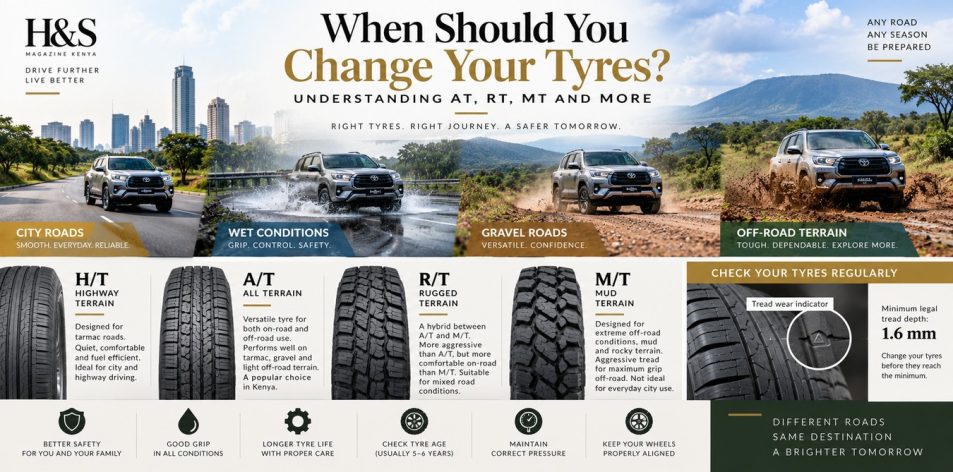
This is where terms such as H/T, A/T, R/T and M/T become important.
What Do H/T, A/T, R/T And M/T Mean?
These letters describe broad tyre categories designed for different types of driving.
H/T – Highway Terrain
H/T generally refers to Highway Terrain tyres. They are designed primarily for road use and are particularly suited to drivers who spend most of their time on paved roads.
They typically prioritise road comfort, handling and relatively quiet driving compared with more aggressive off-road tread designs.
If your normal routine is commuting around Nairobi, Mombasa, Kisumu or another urban area, with occasional trips on good highways, an H/T or road-focused tyre may make more sense than an aggressive off-road tyre.
A/T – All Terrain
A/T stands for All Terrain.
These tyres are designed as a compromise between on-road and off-road driving. They generally have a more aggressive tread than highway tyres while remaining suitable for regular road use.
They can be useful for drivers who regularly move between tarmac, gravel roads, dirt roads and lighter off-road conditions.
BFGoodrich describes all-terrain tyres as being designed to provide traction across a wide range of terrain while offering better on-road manners than mud-terrain tyres.
R/T – Rugged Terrain
R/T generally means Rugged Terrain.
R/T tyres occupy a middle ground between A/T and M/T designs, although the exact construction and positioning varies between manufacturers and individual models.
For example, Toyo describes some of its R/T products as hybrid tyres positioned between all-terrain and mud-terrain categories. Its R/T Trail is positioned between the two, while its R/T Pro is a more aggressive hybrid M/T design.
This makes R/T tyres attractive to drivers who want a tougher, more aggressive tyre for gravel, dirt, sand and occasional challenging terrain without necessarily choosing a full mud-terrain tyre.
M/T – Mud Terrain
M/T stands for Mud Terrain.
These tyres are designed for more demanding off-road conditions, particularly mud, loose soil, rocks and challenging trails.
Their large tread blocks and wider voids are designed to help clear mud and maintain traction on soft and uneven surfaces. However, that aggressive design can come with trade-offs for everyday road driving, including increased road noise and potentially different handling and fuel-consumption characteristics compared with less aggressive tyres.
So Which Tyre Is Right For You?
There is no single tyre type that is automatically right for every driver.
The better question is: what conditions do you regularly drive in?
Consider the roads you use during an ordinary month rather than thinking only about the occasional adventurous trip.
- Mostly tarmac and highways: Consider H/T or road-focused tyres.
- Tarmac plus regular gravel and dirt roads: A/T can be a practical choice.
- Mixed road and more demanding off-road driving: R/T may provide a useful compromise.
- Frequent mud, rocky trails and serious off-road use: M/T may be more appropriate.
Do Not Buy M/T Tyres Just Because They Look Tough
This is a common mistake among SUV and 4×4 owners.
An aggressive tyre can certainly make a vehicle look more capable, but appearance should not determine your tyre choice.
If 95 per cent of your driving is on tarmac, fitting an extremely aggressive mud-terrain tyre simply because you like the appearance may not provide the best match for your everyday driving.
BFGoodrich specifically advises drivers to prioritise the tyre’s ability to perform for their intended use rather than choosing a mud-terrain tyre simply because it looks tougher.
What If You Regularly Drive On Different Conditions?
This is where tyre selection becomes particularly important for Kenyan drivers.
You might leave Nairobi on smooth tarmac, encounter rough sections of road, continue onto gravel and eventually reach a rural property where the final kilometres become muddy after heavy rain.
If this is your normal driving pattern, a road-only tyre may not be the best fit for your lifestyle.
An A/T or suitable R/T tyre may provide a better balance, depending on how severe the off-road sections actually are.
If you frequently encounter deep mud, loose soil and difficult rocky terrain, a more aggressive M/T tyre may be worth considering.
Think About The Rain
Wet roads are one of the most important conditions to consider when choosing and maintaining tyres.
Tread grooves help move water away from the contact area between the tyre and road. As tread wears down, the tyre’s ability to manage water can be affected.
Michelin notes that tread depth plays an important role in water drainage and in helping maintain contact with the road in wet conditions.
This is particularly relevant in areas that experience heavy rainfall, where standing water and wet road surfaces can become a regular driving challenge.
When Should You Actually Change Your Tyres?
Do not wait until a tyre looks completely bald before thinking about replacement.
There are several signs that your tyres need attention.
1. The Tread Has Reached The Wear Indicators
Most modern tyres have tread-wear indicators built into their grooves.
When the surrounding tread becomes level with these indicators, the tyre has reached its wear limit.
Michelin identifies 1.6 mm as the minimum tread depth for cars in the guidance it provides for the relevant jurisdictions, and Kenya’s regulations also specify a 1.6 mm tread requirement for the applicable vehicles.
Do not treat the legal minimum as a target to aim for if your tyres are already showing other signs of deterioration.
2. Cracks Appear On The Sidewall
Inspect the sidewalls regularly for cracks, cuts, bulges or other visible damage.
Tyre damage is not something to ignore simply because there is still plenty of tread remaining.
Michelin identifies visible tears, cracks, cuts, bulges and deformation among the warning signs that require attention.
3. The Tyre Is Wearing Unevenly
Look at the tyre from different angles.
If one side is wearing much faster than the other, or if you notice unusual patches, feathering or excessive shoulder wear, have the vehicle inspected.
Uneven tyre wear can be associated with incorrect inflation, wheel alignment problems or suspension issues.
Simply replacing the tyres without addressing the underlying problem can result in the new tyres wearing out prematurely as well.
4. The Tyre Has Been Damaged
A serious puncture, cut, bulge, exposed structure or other significant damage may mean that a tyre needs to be replaced even when its tread still appears acceptable.
Do not attempt to make your own judgement about structural tyre damage. Have it inspected by a qualified tyre professional.
5. The Tyres Are Getting Old
Tyres age even when the vehicle is not driven very frequently.
Look at the date code on the tyre sidewall. The four-digit date code indicates the week and year of manufacture.
Michelin recommends replacing tyres at 10 years from their date of manufacture as a precaution, even if they appear to be in reasonable condition. It also recommends that tyres which have been in use for more than five years receive a professional inspection at least annually.
Individual tyre manufacturers may have different recommendations, so always check the manufacturer’s guidance for your specific tyres.
Should You Replace All Four Tyres At Once?
Ideally, having four tyres with similar characteristics and comparable levels of wear helps maintain balanced handling.
However, the correct replacement approach depends on your vehicle, drivetrain, tyre condition and manufacturer recommendations.
If only one tyre is damaged, do not simply buy a random replacement and fit it without consulting a tyre professional. The replacement may need to match the other tyres in size, type, construction and performance characteristics.
This is particularly important on four-wheel-drive and all-wheel-drive vehicles, where tyre differences can have implications for the drivetrain.
Do Not Forget Tyre Pressure
Even the best tyre will not perform as intended if it is consistently under-inflated or incorrectly inflated.
Check your tyre pressure regularly and use the vehicle manufacturer’s recommended pressure for the load and driving conditions.
Do not simply use the maximum pressure printed on the tyre sidewall as your normal vehicle setting. The vehicle manufacturer’s recommended pressure is the appropriate starting point.
Correct pressure also helps reduce unnecessary tyre wear.
Alignment And Suspension Can Destroy Good Tyres
You could spend a considerable amount of money on premium tyres and still get poor mileage if your vehicle has an alignment or suspension problem.
If your steering wheel is not centred, the vehicle pulls to one side or the tyres are wearing unevenly, have the vehicle inspected.
Wheel alignment, suspension condition and tyre pressure should all be considered when investigating abnormal tyre wear.
Rotate Your Tyres When Recommended
Tyre rotation can help manage wear, but the correct rotation pattern depends on the vehicle and tyre configuration.
Always follow your vehicle manufacturer’s recommendations. If the manufacturer does not provide a schedule, ask a qualified tyre professional for guidance.
Regular inspections can also identify uneven wear before it becomes a major problem.
Do You Really Need Off-Road Tyres?
Ask yourself how often you actually leave the tarmac.
If you spend most of your time driving through town and only occasionally travel to a rural property, an A/T tyre may already provide more capability than you need from a standard road tyre.
If you regularly travel through muddy tracks, construction sites, farms, game reserves or difficult rural roads, you may need something more aggressive.
The important thing is to match the tyre to your actual lifestyle rather than the image you want your vehicle to project.
A/T Vs R/T Vs M/T At A Glance
| Tyre Type | Best Suited For | On-Road Use | Off-Road Capability |
|---|---|---|---|
| H/T | Highways, city and paved roads | Excellent | Limited |
| A/T | Mixed road, gravel and light off-road use | Very Good | Good |
| R/T | Mixed road and more demanding off-road conditions | Good | Very Good |
| M/T | Mud, rocks and serious off-road driving | Acceptable, depending on model | Excellent |
These are broad categories. Actual performance varies considerably between tyre brands and individual models, so always check the specifications of the particular tyre you are considering.
What About Driving On Sand?
Sand requires its own consideration.
A tyre that performs well in mud is not automatically the perfect tyre for every type of sand, and vehicle weight, tyre pressure, driving technique and terrain all matter.
If you regularly drive on beaches, sandy tracks or desert-like terrain, speak with an experienced tyre professional who understands the conditions you actually encounter.
What About Gravel Roads?
Regular gravel-road driving can expose tyres to sharp stones, impacts and rough surfaces that are uncommon on smooth tarmac.
If gravel makes up a significant portion of your driving, consider a tyre designed for mixed on-road and off-road use rather than choosing purely on-road tyres.
A suitable A/T or R/T tyre may be worth considering depending on the severity and frequency of the gravel-road driving.
What About Mud?
Mud is where the differences between tyre categories become particularly noticeable.
All-terrain tyres can handle many light and moderate off-road conditions, but serious mud can require a more specialised tread design.
Mud-terrain tyres use larger tread blocks and larger voids designed to help clear mud from the tread and maintain traction on soft terrain.
If deep mud is a regular part of your driving rather than an occasional surprise during the rainy season, your tyre choice should reflect that.
Do Not Forget The Spare Tyre
Your spare tyre should not be forgotten when checking the condition of your tyres.
Check its pressure, age and physical condition. A spare tyre that has been sitting underneath the vehicle or in the boot for years may not be ready for use when you actually need it.
Michelin also includes spare tyres in its precautionary 10-year replacement recommendation.
Tyre Maintenance Is Part Of Responsible Driving
Looking after your tyres is not simply about protecting an expensive investment.
Good tyre maintenance is part of being responsible towards yourself, your passengers and other road users.
For a Muslim driver, this also fits naturally with the broader principle of avoiding unnecessary harm and taking reasonable care of responsibilities entrusted to us.
There is no need to make vehicle ownership unnecessarily extravagant. Choose tyres based on safety, suitability, quality and actual need rather than simply choosing the most expensive or most aggressive option.
A Simple Monthly Tyre Check
Once a month, take a few minutes to inspect your tyres.
- Check tyre pressures.
- Inspect the tread.
- Look for cracks and cuts.
- Look for bulges or deformities.
- Check for uneven wear.
- Check the spare tyre.
- Look at the tyre manufacturing date.
- Pay attention to changes in handling, vibration or road noise.
Michelin recommends checking tyre condition at least monthly and before a long journey.
The Bottom Line
Changing tyres should not be based solely on how old they look or how aggressive the tread appears.
The right time to change depends on tread wear, damage, age, uneven wear and the conditions in which you drive.
And when choosing new tyres, think beyond the letters printed on the sidewall.
H/T is primarily road-focused. A/T is designed for a broader mixture of road and off-road conditions. R/T generally sits between all-terrain and mud-terrain designs, although the exact characteristics vary by manufacturer. M/T is designed for more demanding mud and off-road conditions.
If you regularly drive in different conditions, choose the tyre that matches the conditions you actually encounter most often.
Do not choose tyres simply because they look tough. Choose them because they are suitable for your vehicle, your roads, your driving habits and your safety.
After all, the right tyre is not just about getting you there. It is about helping you get there safely.