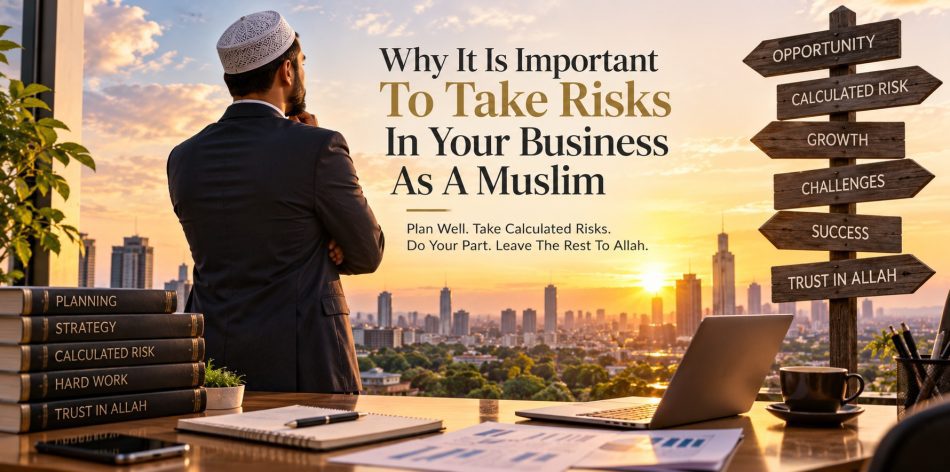
Take The Right Steps, Make The Best Decisions You Can And Then Put Your Trust In Allah
Starting and growing a business requires courage.
At some point, every entrepreneur faces a decision where there is no guarantee of success. You may need to invest in new equipment, hire your first employee, open another branch, launch a new product, enter a new market, change your business model or walk away from something that is no longer working.
There is always an element of uncertainty.
For a Muslim business owner, this uncertainty can sometimes create a deeper question: how do you take risks while still putting your trust in Allah?
The answer is not to avoid every risk.
It is also not to take reckless risks and then say, “I leave it to Allah.”
Islam teaches a balance between taking the necessary means, making responsible decisions and placing your trust in Allah regarding the outcome.
Tawakkul Does Not Mean Doing Nothing
One of the most important principles for a Muslim entrepreneur to understand is that tawakkul does not mean abandoning effort.
In Surah Aal-Imran, Allah instructs the Prophet Muhammad ﷺ to consult others and make a decision, and then to put his trust in Allah. The sequence is important: consultation and decision-making come before reliance upon Allah.
This provides a powerful lesson for business.
You research the market. You examine the numbers. You consult people with experience. You consider the risks. You make your decision. Then you trust Allah with what happens next.
“Tie It And Trust In Allah”
A well-known narration attributed to the Prophet Muhammad ﷺ captures this principle in a simple way.
A man asked whether he should leave his camel untied and rely upon Allah or tie it and rely upon Allah. The response was to tie it and then rely upon Allah. The narration is recorded in Jami’ at-Tirmidhi 2517 and has been graded Hasan by scholars including al-Albani.
The lesson is straightforward: take reasonable precautions and use the means available to you, while placing your ultimate trust in Allah.
For a business owner, “tie the camel” might mean preparing a proper budget, checking a contract, researching customers, getting professional advice, testing a product, protecting your cash flow and having a contingency plan.
Then, after doing what you reasonably can, you accept that the final outcome is not completely within your control.
Business Without Risk Does Not Really Exist
There is no such thing as a completely risk-free business.
Even if your company is established and profitable, circumstances can change.
Customers can leave. Competitors can enter the market. Technology can change. Costs can increase. Regulations can change. Suppliers can fail. A new opportunity can appear that requires you to make a decision quickly.
Trying to eliminate every possible risk can therefore prevent a business from growing.
The objective should not be to eliminate risk altogether. It should be to understand the risk and manage it responsibly.
There Is A Difference Between Calculated Risk And Recklessness
This distinction is particularly important.
Taking a calculated business risk means you have considered the potential benefits, the possible losses and what you can realistically afford to lose.
Recklessness is different.
If you put your family’s essential finances at risk, take on debt you have no realistic ability to repay, enter an arrangement you have not investigated or invest money simply because someone promises you extraordinary returns, that is not automatically transformed into good decision-making because you say you trust Allah.
Tawakkul should not be used as an excuse for poor planning.
Do Your Homework Before You Take The Risk
Before making a significant business decision, gather as much relevant information as reasonably possible.
Ask yourself:
- What exactly am I trying to achieve?
- How much will this decision cost?
- What could go wrong?
- What is the realistic potential benefit?
- Can my business survive if the plan does not work?
- What is the worst reasonable outcome?
- Can I reduce the potential loss?
- Have I spoken to people with relevant experience?
- Have I considered whether the opportunity is Shariah-compliant?
- What is my exit plan if circumstances change?
The more significant the decision, the more seriously you should approach this process.
Consult People Who Know More Than You
Entrepreneurs sometimes make the mistake of believing that asking for advice makes them look weak.
The opposite can be true.
A successful business owner may have excellent knowledge of sales but limited knowledge of accounting. Another may understand marketing but know very little about employment law. Someone else may have years of experience in the exact industry you are considering entering.
Consulting people with relevant expertise can help you identify risks that you may not have considered.
This also fits naturally with the Qur’anic instruction to consult in matters before making a decision and then relying upon Allah.
Do Istikhara When Appropriate
For a Muslim, business decisions can also involve seeking guidance from Allah through dua and, where appropriate, Salat al-Istikhara.
But Istikhara should not be treated as a replacement for research.
You can investigate the opportunity, speak to knowledgeable people, assess the numbers, consider the risks and then ask Allah for what is best.
Seeking Allah’s guidance and taking practical steps do not have to be competing ideas.
Do Not Wait For A Perfect Opportunity
One reason businesses remain small is that the owner keeps waiting for the perfect moment.
The economy must improve. The market must become clearer. The competition must disappear. The perfect employee must appear. The perfect premises must become available.
Sometimes, waiting is sensible.
But sometimes, waiting indefinitely simply becomes another form of fear.
There comes a point where you have gathered the information you reasonably can, considered the risks and need to make a decision.
That is where courage and tawakkul become important.
Start Small When You Can
Taking a risk does not necessarily mean putting everything on the line.
If you want to introduce a new product, test it with a smaller quantity first.
If you want to enter a new market, consider starting with a pilot project.
If you want to introduce a new service, test the demand before building an expensive infrastructure around it.
If you want to hire additional staff, understand whether the additional revenue or productivity can realistically support the cost.
Reducing the size of the initial risk can allow you to learn without exposing the entire business to unnecessary danger.
Do Not Be Afraid Of Failure
One of the biggest reasons entrepreneurs avoid taking risks is fear of failure.
But failure and wrongdoing are not the same thing.
If you made a sincere effort, conducted reasonable research, acted honestly and the venture did not work, you have still gained knowledge that can influence your next decision.
Qur’an 53:39 reminds believers of the importance of striving and effort.
That does not mean every effort will produce the result you wanted. It means that sincere effort itself matters.
Sometimes Allah Closes A Door For A Reason
Every entrepreneur experiences opportunities that do not work out.
You may lose a major customer. A proposed partnership may collapse. A new branch may not perform as expected. A product may fail to gain traction.
It can be difficult to understand why something you worked so hard for did not succeed.
This is where tawakkul can provide perspective.
You are responsible for your choices and your effort. You are not in control of every consequence.
Sometimes the outcome you initially consider a failure may lead you towards a different opportunity or teach you something that becomes valuable later.
Do Not Confuse Tawakkul With Chasing Every Opportunity
Taking risks does not mean saying yes to everything.
A Muslim entrepreneur should still have principles.
An opportunity involving deception, gambling, prohibited products, interest-based arrangements or other clearly impermissible activity should not become acceptable simply because it appears profitable.
Business growth should remain within the boundaries of your values.
Sometimes the biggest act of courage is saying no to money that you believe you cannot earn in a halal manner.
Protect Your Reputation
A business decision can affect much more than your bank account.
It can affect your employees, customers, suppliers, family and reputation.
Before taking a major risk, consider who else could be affected.
Do not make a decision that could leave employees unpaid simply because you want to chase an uncertain opportunity. Do not make promises to customers that you are not reasonably capable of fulfilling. Do not put suppliers in an impossible position.
A Muslim entrepreneur should strive to conduct business with honesty, fairness and responsibility.
Do Not Let Fear Control Your Business
There is a difference between being cautious and being paralysed by fear.
You can spend months analysing an opportunity and still never have complete certainty.
At some point, you have to make a decision with the information available to you.
This is particularly true in competitive markets. If you never introduce new services, never invest in your team, never improve your technology and never explore new customers, competitors who are willing to adapt may move ahead.
Know What You Can Control
One of the healthiest ways to approach business uncertainty is to separate what you can control from what you cannot.
You can control:
- Your preparation
- Your honesty
- Your work ethic
- Your research
- Your customer service
- Your spending decisions
- Your contracts
- Your communication
- Your response when something goes wrong
You cannot completely control:
- Market conditions
- Customer behaviour
- Competitors
- Economic changes
- Unexpected events
- Other people’s decisions
- The final outcome of every business venture
Do what is within your control and leave what is beyond your control to Allah.
Have A Plan For The Worst Reasonable Outcome
Before taking a major risk, ask yourself what happens if it does not work.
If you invest KES 2 million into a new business initiative, what happens if it produces no return for twelve months?
If you hire five new employees, what happens if sales do not grow as expected?
If you open a new location, how long can you sustain the additional rent and operating costs?
Thinking about these questions does not mean that you lack faith.
It means you are taking the responsibility seriously.
Keep Your Business Finances Under Control
One of the easiest ways to make a manageable business risk become a dangerous one is to lose control of cash flow.
Keep track of your income, expenses, receivables, commitments and available cash.
Do not assume that projected sales are the same as money already in the bank.
Maintain appropriate reserves where possible and understand how long your business can continue operating if revenue temporarily falls.
Good financial discipline gives you greater freedom to take sensible risks because you are not making every decision from a position of desperation.
Growth Requires Courage
There are times when staying exactly where you are is itself a risk.
A business that refuses to adapt can eventually lose customers to competitors that are more innovative.
Technology changes. Customer expectations change. Markets change.
Sometimes you need to invest in a new system, train your employees, improve your website, introduce a new service, change your pricing or enter a new market simply to remain competitive.
That does not mean you should chase every trend.
It means you should be willing to make thoughtful changes when the evidence supports them.
Remember That Provision Comes From Allah
A Muslim business owner should work hard, but should also remember that ultimate provision is from Allah.
This does not mean abandoning commercial discipline or pretending that financial results do not matter.
It means that your business is a means, not the ultimate source of your provision.
This perspective can help reduce the fear that sometimes prevents entrepreneurs from making necessary decisions.
You do your part. You work honestly. You seek opportunities. You serve your customers. You manage your business responsibly. You make dua. And you trust Allah with the outcome.
Do Not Measure Success Only By Money
A business can generate substantial revenue and still be unsuccessful in ways that matter.
If the owner has sacrificed every relationship, compromised their principles, treated people unfairly or lost their peace of mind, the financial result tells only part of the story.
For a Muslim entrepreneur, success can also include earning halal income, treating people fairly, providing employment, serving customers honestly, supporting family and contributing positively to society.
When A Risk Does Not Work
If a calculated business decision fails, resist the temptation to immediately conclude that you made a foolish decision.
Review what happened.
Was the original information inaccurate? Did circumstances change? Was the execution poor? Did you underestimate the costs? Was the market smaller than expected?
Learn from the experience.
Then decide whether to improve the idea, change direction or walk away.
Trusting Allah does not mean refusing to learn from experience.
Take The Risk, But Take The Means
Perhaps the simplest way to approach business risk as a Muslim is this:
Research.
Plan.
Consult.
Calculate.
Make sure the opportunity is halal.
Take reasonable precautions.
Make the decision.
Work hard.
Make dua.
Then put your trust in Allah.
Your Business Is A Journey, Not A Single Decision
There will be good months and difficult months. There will be decisions that produce excellent results and others that teach you valuable lessons.
You cannot know every outcome in advance.
What you can do is approach each decision with sincerity, knowledge, courage and responsibility.
The Qur’an reminds us that a person has what they strive for, while also teaching believers to place their trust in Allah.
So do not allow fear of uncertainty to stop you from building something worthwhile.
Take the necessary steps. Tie your camel. Make the best decision you can with the knowledge available to you.
Then leave the rest to Allah.