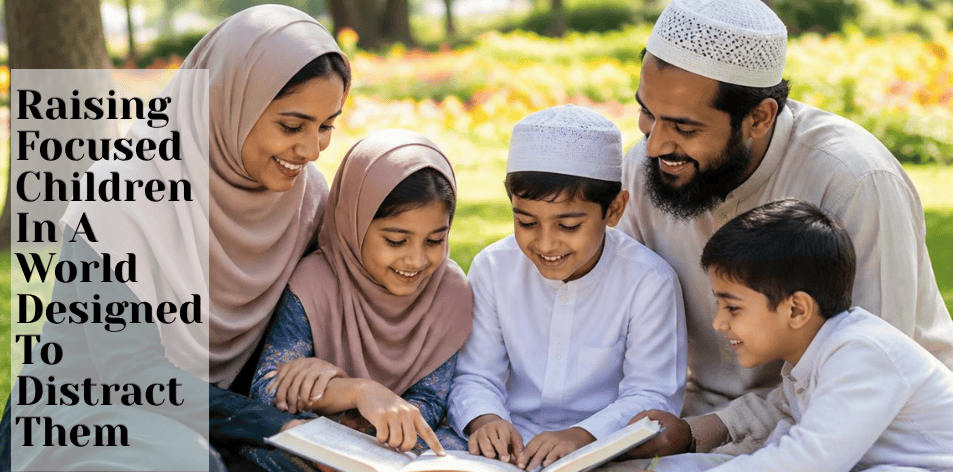
Helping Attention Survive In The Age Of Constant Noise
We live in a world that is constantly asking for our attention.
Notifications appear on screens, videos automatically play one after another, advertisements compete for our eyes and entertainment is available whenever we want it. For children growing up surrounded by this constant stimulation, simply sitting quietly and concentrating on one thing can become surprisingly difficult.
Focus is no longer something we can assume children will naturally develop. It is a skill that needs to be protected, practised and modelled.
Why Focus Is a Life Skill
Focus is about far more than completing homework.
A child who learns to concentrate is developing the ability to listen carefully, understand difficult ideas, complete tasks and resist the temptation to move constantly from one activity to another.
Over time, sustained attention helps children develop:
✔️ Better learning and comprehension
✔️ Greater patience
✔️ Stronger problem-solving skills
✔️ Improved emotional regulation
✔️ Greater perseverance
✔️ The ability to work towards long-term goals
A child who can remain focused when something is difficult is also learning an important lesson: not everything worthwhile is immediately entertaining.
The Problem With Constant Stimulation
Children do not necessarily need more entertainment. In many cases, they need more opportunities to experience less stimulation.
When every quiet moment is immediately filled with a screen, music, games or videos, children may have fewer opportunities to become comfortable with boredom, reflection and independent thought.
Boredom itself is not necessarily a problem.
A child sitting quietly and wondering what to do may eventually invent a game, pick up a book, draw something, explore an interest or simply allow their imagination to work.
Sometimes, a little boredom gives the mind room to breathe.
Create a Calmer Home Environment
The home does not need to be completely silent or screen-free. Instead, parents can deliberately create periods where unnecessary stimulation is reduced.
Consider introducing simple habits such as:
✔️ Screen-free meals
✔️ A quiet reading period each day
✔️ Turning off unnecessary notifications
✔️ Keeping televisions off when nobody is watching
✔️ Creating a calm homework environment
✔️ Having periods when phones are put away
These small changes teach children that they do not need to respond to every notification, message or source of entertainment immediately.
Teach Children to Do One Thing at a Time
Multitasking may appear productive, but children often benefit from learning to concentrate on one task before moving to another.
Instead of doing homework while watching videos and constantly checking messages, encourage children to complete one activity with their full attention.
This can be particularly useful for younger children.
Start small.
A child who can concentrate for ten uninterrupted minutes can gradually work towards fifteen, twenty and eventually longer periods.
Focus develops through practice, not pressure.
Bring Back the Joy of Reading
Reading is one of the simplest ways to strengthen attention.
Unlike short-form videos, a book asks children to remain with a story or idea for longer. They have to follow characters, remember details, imagine scenes and connect one part of the story with another.
Parents can encourage this by making reading enjoyable rather than treating it solely as another academic responsibility.
A comfortable chair, a regular reading time and allowing children to choose age-appropriate books they genuinely enjoy can make a significant difference.
Teach Children to Be Present
Focus is also about being present with other people.
When your child is speaking, try putting your phone aside and giving them your full attention.
Look at them.
Listen without immediately interrupting.
Ask questions.
Allow them to finish their thought.
These simple interactions communicate something powerful:
“You are important enough for me to give you my attention.”
Children who experience this from their parents are more likely to understand the value of giving attention to others.
Parents Are the Most Powerful Example
Children notice what adults do.
It is difficult to teach a child to put their phone away during dinner while constantly checking our own notifications.
If we want children to develop healthier relationships with technology, we should examine our own habits too.
Parents can model focus by:
✔️ Putting devices aside during family conversations
✔️ Reading rather than constantly scrolling
✔️ Completing tasks without repeatedly checking the phone
✔️ Practising quiet moments
✔️ Giving children undivided attention
We do not need to be perfect.
We simply need to demonstrate that we, too, are learning to protect our attention.
Focus and Islamic Values
For Muslim families, developing focus can also be connected to the broader values of khushu’, patience and mindfulness of Allah.
Salah provides a powerful example of stepping away from the distractions of everyday life and directing our attention towards worship.
Children can gradually learn that not every moment needs to be filled with noise. Quiet reflection, reading Qur’an, making du’a and simply taking time away from constant stimulation can help create an appreciation for stillness and presence.
The goal is not to make every moment serious.
Children should play, laugh and enjoy themselves.
Rather, they should learn that they are in control of their attention rather than allowing every distraction to control them.
Don’t Expect Instant Results
A distracted child is not necessarily lazy or undisciplined.
Children are developing their ability to regulate attention, and today’s environment makes that task particularly challenging.
If a child struggles to concentrate, begin with manageable changes rather than demanding hours of uninterrupted focus.
Praise effort.
Celebrate progress.
Be consistent.
And remember that attention is built gradually.
In a world competing constantly for our children’s attention, helping them develop focus may be one of the most valuable gifts we can give them.
Focus allows children to learn deeply, listen carefully, think independently and remain committed when something becomes difficult.
We cannot remove every distraction from their lives—and we should not try to.
Instead, we can teach them something far more valuable:
They can choose where their attention goes.
When parents create calmer environments, establish healthy routines, model focused behaviour and make space for reflection, children gradually learn to replace constant noise with clarity, intention and depth.