Children today have more opportunities for entertainment than ever before. Between school, homework, television, smartphones, tablets, gaming and social media, it can be surprisingly easy for physical activity to become something that happens only when there is time left over.
But children need movement as part of everyday life.
Regular physical activity is not only about developing fitness or preparing a child to become an athlete. It can also help children learn consistency, patience, self-control, responsibility and the importance of looking after their bodies.
For Muslim parents, this can fit naturally into the wider values we want to teach our children. Islam encourages moderation, responsibility and taking care of the body Allah has entrusted to us. Building a routine around movement can therefore become about much more than exercise.
It can become an opportunity to teach discipline.
Why Routine Matters More Than Motivation
One of the biggest lessons parents can teach children is that we should not rely entirely on feeling motivated before doing something worthwhile.
There will be days when a child wants to run outside and days when they would rather remain on the sofa.
There will be days when homework feels difficult, the weather is unpleasant or everyone is tired.
A healthy routine teaches children that some activities are simply part of the day.
Just as brushing their teeth, attending school, helping around the home and preparing for salah can become routines, physical activity can become something they expect to do rather than something they have to be persuaded to do every time.
Children Do Not Need To Become Athletes
Physical discipline does not mean turning every child into a competitive athlete.
Some children will love football, swimming or athletics. Others may prefer cycling, walking, skipping, martial arts, hiking, playing in the garden or simply running around with their friends.
The goal is to develop an active lifestyle that is appropriate for the child’s age, ability and interests.
WHO recommends that children and adolescents aged 5–17 accumulate an average of at least 60 minutes of moderate-to-vigorous physical activity per day across the week. The activity can come from play, sport, walking or cycling, recreation, physical education and other everyday activities. WHO also recommends incorporating vigorous activities that strengthen muscles and bones at least three days a week.
That does not mean a child needs to spend an hour every day doing a formal workout.
Active play counts too.
Start With Movement, Not Exercise
The word “exercise” can make physical activity sound like a chore.
For younger children especially, movement should often feel like play.
Run together. Kick a ball. Walk to the shops when practical. Play tag. Ride bicycles. Jump rope. Go swimming. Explore a park. Play outdoors with siblings.
Children do not need a gym membership to become physically active.
In fact, making movement part of ordinary family life can be more sustainable than creating a complicated workout programme.
Build A Daily Activity Routine
A good children’s exercise routine does not need to be complicated.
For example, a family could establish a simple pattern such as:
- A short morning stretch or mobility routine.
- Walking whenever practical rather than always using a vehicle.
- Active outdoor play after school.
- A family walk after dinner when circumstances allow.
- Sports practice on selected days.
- Weekend outdoor activities.
The exact routine will depend on the child’s age, school schedule, interests and family circumstances.
What matters is consistency.
Use Family Exercise To Lead By Example
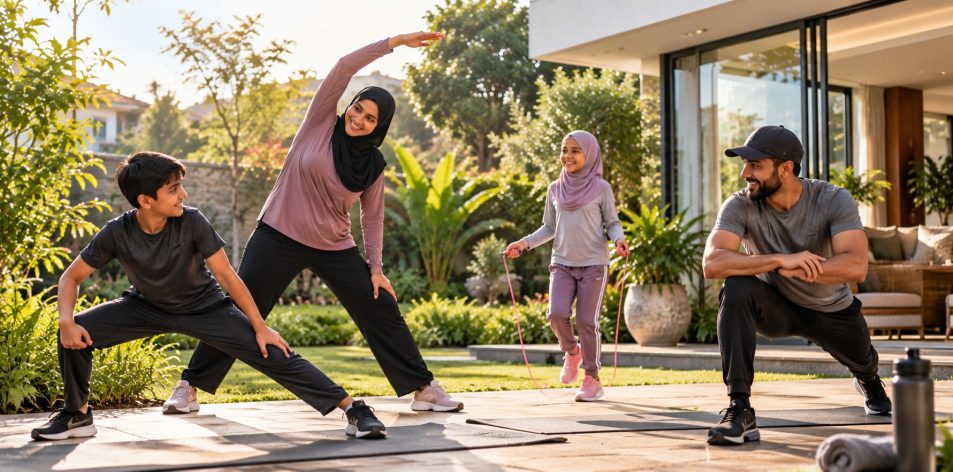
Children are far more likely to view physical activity as normal when they see their parents being active too.
If parents spend the evening sitting in front of screens while telling children that they should exercise, the message can become difficult to take seriously.
Instead, make activity something the family does together.
Go for a walk. Play a game. Take the children swimming. Spend time outdoors. Do a simple stretching routine together.
It does not have to be intense.
The message is simply that looking after your body is something the whole family values.
Connect Physical Discipline With Other Good Habits
Exercise can become part of a wider routine of personal responsibility.
Children can learn to:
- Prepare their clothes or sports equipment.
- Fill their water bottle.
- Put equipment away afterwards.
- Arrive on time for activities.
- Warm up before more vigorous activity.
- Stretch or cool down when appropriate.
- Look after shared equipment.
- Keep their sports shoes and clothing organised.
These may seem like small things, but they teach children that discipline is about actions, not simply intentions.
Teach Children That Consistency Beats Intensity
A child does not need to have an exhausting workout to have a successful active day.
Parents sometimes make the mistake of thinking that exercise only counts if everyone is sweating heavily or completely exhausted.
That approach can make children associate physical activity with discomfort.
Instead, teach them that regular movement matters.
A 30-minute game today, a family walk tomorrow and swimming at the weekend can all contribute to an active lifestyle.
As children become fitter and older, activities can gradually become more challenging.
Make Exercise Age-Appropriate
Children are not simply smaller versions of adults.
The type, intensity and duration of physical activity should be appropriate for their age and ability.
Younger children generally benefit from plenty of opportunities for active play, while older children and teenagers can gradually take on more structured sports and exercise.
Parents should also consider individual differences. A child with a medical condition, injury, disability or other specific concern may need advice from an appropriate healthcare professional about what activities are suitable.
Do Not Turn Exercise Into A Weight-Loss Programme
Children need to develop a healthy relationship with food, movement and their bodies.
Constantly talking about weight, appearance or burning calories can create unnecessary pressure.
For children, the emphasis should generally be on being strong, active, healthy, energetic and capable rather than trying to achieve a particular appearance.
Exercise should be something they learn to enjoy and value throughout life.
Teach Children To Pay Attention To Their Bodies
Physical discipline should not mean ignoring pain or exhaustion.
Children should learn the difference between the normal effort of exercise and warning signs that something is wrong.
Teach them to communicate when they are experiencing unusual pain, dizziness, breathing difficulties or other concerning symptoms.
Rest is also part of physical discipline.
A child does not need to push through every situation simply to prove that they are tough.
Mindfulness Can Be Part Of Exercise
Physical activity can also provide an opportunity to teach children mindfulness.
When walking together, encourage them to notice their surroundings. When running, help them pay attention to their breathing and movement. During stretching, teach them to concentrate on how their body feels.
They do not need complicated mindfulness techniques.
Sometimes it is simply about teaching children to be present rather than constantly distracted by a screen.
A family walk can become a conversation. A bike ride can become an opportunity to explore. A garden game can become a lesson in patience and cooperation.
Keep Screens From Taking Over The Day
Children do not necessarily need to eliminate screens from their lives. Technology is part of modern education, communication and entertainment.
The challenge is balance.
WHO recommends limiting sedentary behaviour among children and adolescents, particularly recreational screen time. Its guidelines also note that higher amounts of sedentary behaviour are associated with several poorer health outcomes.
One practical approach is to create clear transitions.
For example, after homework, a child might spend time outdoors before returning to recreational screen use.
The aim is not to make screens forbidden. It is to ensure that screens do not automatically become the default activity whenever a child has free time.
Make Outdoor Activity Part Of Family Life
Where it is safe and practical, outdoor activity can provide variety and fresh air.
Families can explore parks, walking trails, gardens, sports grounds and other appropriate outdoor spaces.
In Kenya, families have many opportunities to make movement part of weekend activities, from walking and cycling to swimming, hiking and playing outdoor games.
The important thing is to choose activities that are appropriate for the family and the environment.
Use The Weekend To Break The Routine
School days can be structured and busy.
Weekends provide an opportunity to introduce longer periods of activity without making them feel like another school assignment.
A Saturday morning walk, family football game, swimming session, cycling trip or visit to an outdoor recreational space can give children something active to look forward to.
Parents can also alternate activities so that the children do not feel that every weekend is exactly the same.
Teach Children About Competition In A Healthy Way
Sport naturally introduces competition.
Competition can teach children effort, teamwork, resilience and how to handle disappointment.
But parents should be careful not to make winning the only measure of success.
Ask questions such as:
- Did you give your best effort?
- Did you encourage your teammates?
- Did you follow the rules?
- Did you learn something?
- Did you show good character when things did not go your way?
These questions help children understand that character matters as much as the result.
Teach Good Sportsmanship
Physical discipline is also an opportunity to teach manners and character.
Children can learn to respect coaches, teammates, opponents and officials.
They can learn to win without arrogance and lose without becoming bitter.
They can learn that making a mistake does not mean giving up.
For Muslim families, this fits naturally with the wider emphasis on good character, patience, fairness and controlling one’s behaviour.
Choose Activities That Fit Your Family’s Values
Parents should consider the environment surrounding an activity as well as the exercise itself.
For Muslim families, this may include considering appropriate clothing, the environment, schedules around salah, supervision and whether the activity is suitable for the family’s values.
This does not mean children need to be excluded from healthy recreation.
It simply means parents can choose thoughtfully.
There are many options, including swimming, athletics, cycling, football, basketball, martial arts, walking, hiking, gymnastics and many other forms of physical activity, depending on the child and the family’s circumstances.
Build Salah Into The Rhythm Of The Day
For Muslim families, daily life already has natural points of structure through the five daily prayers.
Parents can use these established rhythms when organising family routines without turning exercise into an act of worship itself.
For example, a family might go for a walk before Maghrib, play outside after school before the evening routine or use a suitable period after Fajr for gentle movement, depending on the family’s schedule and the children’s ages.
The purpose is simply to make physical activity fit naturally into family life while keeping salah properly prioritised.
Teach Children That Their Bodies Are An Amanah
One of the most meaningful ideas Muslim parents can introduce is that our bodies are a trust.
Looking after ourselves does not mean becoming obsessed with appearance or fitness.
It means treating our health responsibly.
Good food, adequate sleep, regular movement, cleanliness, rest and sensible habits can all be part of taking care of ourselves.
This perspective can help children understand that physical activity is not simply about looking fit. It is about being able to live, learn, work, worship and participate in family and community life with greater strength and energy.
Do Not Make Exercise A Punishment
One habit parents should avoid is using exercise as punishment.
If a child misbehaves and is repeatedly told to “go and run” or perform physical exercises as a punishment, they may begin to associate movement with something unpleasant.
Exercise should generally be presented as a positive part of life.
There are many other appropriate ways to teach consequences, responsibility and discipline without turning physical activity into something children learn to dislike.
Let Children Have Some Choice
Consistency becomes easier when children have some ownership over what they do.
You can give them a choice between two or three suitable activities.
“Would you rather go for a walk or play football?”
“Would you like to cycle or go swimming this weekend?”
The parent remains responsible for setting healthy boundaries, but the child gets some control over the activity.
This can be particularly useful as children become older and begin developing stronger personal preferences.
Create A Simple Weekly Activity Plan
Families do not need complicated fitness schedules.
A simple weekly plan might look like this:
- Monday: 30-minute family walk or active outdoor play.
- Tuesday: Sport or structured activity.
- Wednesday: Active games or cycling.
- Thursday: Walking, stretching and outdoor play.
- Friday: Family activity suited to the day’s schedule.
- Saturday: Longer outdoor activity, swimming, hiking or sport.
- Sunday: Active family outing or relaxed movement.
This is only an example. Families should adjust the routine to the children’s ages, school commitments, weather, safety considerations and individual needs.
The key is to create a pattern that the family can actually maintain.
Start Small If Your Child Is Currently Inactive
If a child currently spends most of their free time sitting, do not suddenly demand an intense daily workout.
WHO’s guidelines specifically recognise that some activity is better than none and recommend that children who are not currently meeting activity recommendations start with smaller amounts and gradually increase frequency, intensity and duration.
Start with a walk.
Play outside for 20 minutes.
Introduce a simple game.
Then gradually build the routine.
Small improvements that become permanent habits are often more useful than ambitious plans that last only a week.
Remember That Parents Are Building Habits For Life
The ultimate objective is not to make a child exercise because their parents are watching.
It is to help them develop habits that remain when nobody is watching.
A child who grows up understanding that movement, health, rest, discipline and balance are normal parts of life is more likely to carry those principles into adulthood.
That is why consistency matters more than creating the perfect children’s fitness programme.
Physical Discipline Is About More Than Fitness
When parents introduce regular activity into family life, they are teaching much more than physical fitness.
Children learn to show up even when they are not particularly motivated. They learn to practise. They learn to rest. They learn to deal with setbacks. They learn to respect others. They learn to look after their equipment and their bodies. They learn that progress takes time.
These lessons can influence many other areas of life.
Make Movement A Normal Part Of Growing Up
Children do not need perfect routines.
They need parents who understand the value of consistency and create reasonable opportunities for them to move, play and develop physical confidence.
For Muslim families, this can sit comfortably alongside the values we already try to instil: discipline, moderation, responsibility, patience, good character and gratitude for the abilities Allah has given us.
So start with something simple.
Take a walk together. Play outside. Go swimming. Ride bicycles. Practise a sport. Stretch in the garden. Spend less time sitting and more time moving.
Then do it again tomorrow.
Because physical discipline is rarely built through one intense workout. It is built through the small decision to keep moving, keep practising and keep showing up.