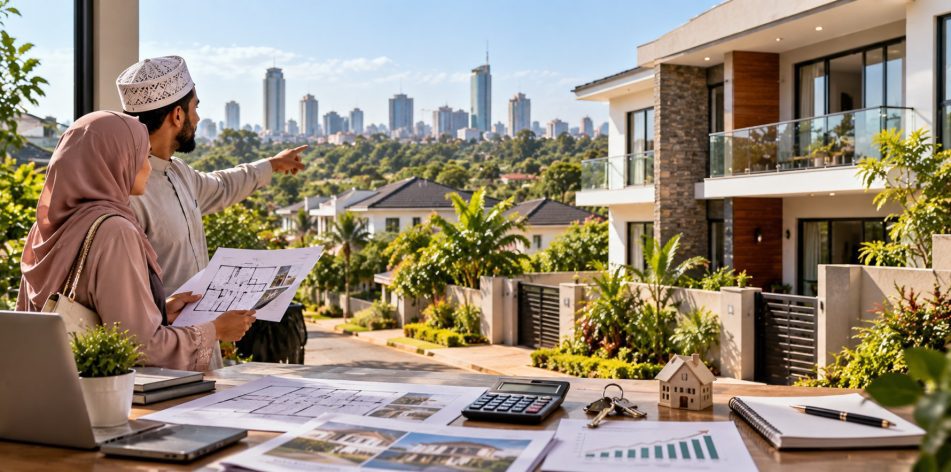
Buying your first home is one of the biggest financial decisions you are likely to make. In Nairobi, where property prices can vary dramatically from one neighbourhood to another, first-time homebuyers have to balance several competing priorities: affordability, location, quality, family needs, financing and the property’s potential to hold or increase its value over time.
For a Muslim buyer, there is another important consideration: how the purchase is financed and whether the transaction is consistent with your financial principles.
That does not mean that buying a home has to be complicated. With proper planning, research and professional advice, it is possible to find a property that works for your family today while also making financial sense for the future.
Here is how to approach the Nairobi property market if you are buying your first home.
Start With Your Budget, Not The Property
One of the most common mistakes first-time homebuyers make is falling in love with a property before working out what they can realistically afford.
Nairobi has no shortage of attractive homes and apartments. Once you start viewing properties, it is very easy to increase your budget because the next property has a slightly larger kitchen, better finishes, an extra bedroom or a more desirable location.
Instead, determine your financial limit first.
Look at your household income, existing financial commitments, savings, expected deposit, monthly household expenses and the additional costs associated with buying a property.
Your home should provide security and stability rather than becoming a source of constant financial pressure.
Do Not Budget Only For The Purchase Price
The advertised property price is not necessarily the amount you will need to complete the purchase.
Depending on the transaction, you may need to account for costs such as legal fees, valuation, stamp duty, registration, searches, financing-related charges, insurance, moving costs, renovations and initial furnishing.
There may also be ongoing costs such as service charges for apartments or gated developments, property maintenance, security, utilities, rates and insurance.
Before making an offer, create a complete homebuying budget rather than simply asking, “Can I afford the selling price?”
Decide What You Actually Need
Before looking at Nairobi property listings, make two lists.
The first should contain your genuine requirements. The second should contain things that would be nice to have.
Your requirements might include:
- A specific number of bedrooms.
- Reasonable access to work or school.
- Reliable water supply.
- Secure surroundings.
- Parking.
- A manageable service charge.
- A suitable environment for children.
- Good road access.
- Proximity to family or important services.
Your wish list might include a swimming pool, gym, large balcony, rooftop entertainment area, staff accommodation or premium finishes.
Knowing the difference can prevent you from paying significantly more for features that you do not actually need.
Location Can Matter More Than Finishes
A beautifully finished apartment in an inconvenient location can become frustrating very quickly.
When evaluating Nairobi property, think beyond the appearance of the building.
Consider your daily commute, access to major roads, schools, hospitals, shopping areas, places of worship and other facilities that matter to your household.
Also think about how the neighbourhood could change over the next five or ten years.
Infrastructure improvements, new commercial developments, changing traffic patterns and increased construction can all affect how attractive a location becomes.
Do Not Assume Every Nairobi Neighbourhood Will Perform The Same Way
One of the biggest lessons for first-time homebuyers is that Nairobi is not a single property market.
Performance can vary considerably between neighbourhoods and between property types within the same neighbourhood.
A particular area may have strong demand for family houses but weaker demand for apartments. Another may have attractive rental demand but limited potential for capital appreciation. A satellite location may offer a lower entry price but involve a significantly longer commute.
This is why statements such as “property always goes up” should be treated carefully.
Research the specific neighbourhood, property type and price range you are considering rather than relying on general property-market assumptions.
Think About The Property’s Future Demand
If you are buying a home primarily for your family, your personal needs should come first.
However, it is still sensible to consider future demand.
You may eventually need to sell the property, rent it out or use it as part of your family’s wider financial planning.
Ask yourself:
- Would another family want to live here?
- Is the location convenient?
- Is the property layout practical?
- Is there adequate parking?
- Are the monthly service charges reasonable?
- Is the development well maintained?
- Is the neighbourhood attracting or losing residents?
- Are there schools, businesses, transport links and other amenities nearby?
- Will the property still appeal to buyers several years from now?
You do not need to predict the future. You simply need to avoid ignoring the factors that influence future demand.
Apartment Or Standalone House?
For many first-time buyers in Nairobi, the decision comes down to an apartment, townhouse or standalone house.
Each has different advantages.
An apartment may offer a lower entry price, security, shared amenities and potentially lower maintenance responsibilities. However, you need to understand the service charge, management arrangements, sinking fund, parking allocation and rules governing the development.
A townhouse can provide more space while still offering some of the benefits of a managed development.
A standalone house generally gives you greater control over the property and land, but it can require more capital and greater responsibility for security, maintenance, landscaping and infrastructure.
Do not automatically assume that the most expensive property is the best investment. Match the property type to your needs, finances and intended holding period.
Look Beyond The Show House
Developers are very good at presenting properties at their best.
That is exactly why you should look beyond the show house.
Visit the property at different times of day if possible. Look at the surrounding roads, drainage, noise levels, parking, neighbouring properties and general condition of the development.
If you are buying an apartment, visit the building when residents are actually using it. Ask about lifts, water pressure, backup systems, security, waste collection and service-charge management.
A property can look perfect during a Saturday afternoon viewing and feel very different on a Monday morning.
Investigate The Title And Ownership
Never rely solely on the seller, agent or developer to tell you that everything is in order.
Property due diligence is essential.
An official land search can help establish the registered ownership of the property and identify encumbrances such as charges, cautions or restrictions. Kenya’s State Department for Lands identifies the official search certificate as an important part of due diligence before transactions involving land and property.
For property purchases, use a qualified property lawyer to guide the legal process and verify the documents.
Do not transfer a large amount of money simply because someone has provided you with a copy of a title or sale agreement.
Check The Physical Property Against The Documents
Legal due diligence should be accompanied by physical due diligence.
Where relevant, confirm the property’s boundaries, dimensions, access, development approvals and other details with the appropriate professionals.
This is particularly important when purchasing land or a standalone house.
The State Department for Lands also provides survey search services that can help verify information such as boundaries, beacons and survey records.
If something about the property does not match the documentation, stop and investigate before proceeding.
Be Careful With Off-Plan Property
Off-plan property can provide an opportunity to buy at an earlier stage of development, but it also comes with additional considerations.
Before committing, investigate the developer’s track record, previous projects, approvals, completion history, ownership of the underlying land and contractual terms.
Understand exactly what is included in the purchase price.
Do not rely solely on computer-generated images showing what the development is supposed to look like.
Ask for specifications, floor plans, timelines, payment schedules, completion provisions and the legal documents relating to the transaction.
Understand Service Charges Before Buying An Apartment
A surprisingly important part of apartment ownership is the monthly service charge.
A property that appears affordable can become considerably more expensive if the service charge is high or frequently increases.
Ask what the service charge covers.
Does it include security, cleaning, landscaping, water for common areas, lifts, generator costs, swimming-pool maintenance and other shared facilities?
Also ask about the financial health and management of the development.
Are there outstanding service-charge arrears? Is there a sinking fund? Are major repairs expected? Are there disputes among owners?
These questions can tell you a great deal about the property you are considering.
Calculate The Real Cost Of Ownership
Do not compare homes solely by their selling price.
Compare the total cost of owning each property.
For example, a cheaper apartment with a high service charge and expensive parking arrangements may not be significantly cheaper over ten years than a slightly more expensive property with lower recurring costs.
Likewise, a house that requires extensive renovation may initially appear affordable but ultimately cost much more than a move-in-ready property.
Consider the purchase price, transaction costs, financing costs, renovations, maintenance, service charges, insurance, utilities and expected future repairs.
Consider Your Financing Carefully
For many first-time homebuyers, financing will determine what is realistically possible.
Kenya’s mortgage market has been changing, and financing costs can have a significant effect on the total cost of home ownership.
If you are considering conventional mortgage financing, understand whether the rate is fixed or variable, how repayments could change and the total amount you could pay over the life of the facility.
Do not make your decision based solely on the monthly repayment advertised by the lender.
For Muslim Buyers, Consider Shariah-Compliant Home Finance
For Muslims who want their property purchase to comply with their understanding of Shariah, the financing structure deserves particular attention.
Rather than simply asking whether a lender calls something “home finance”, understand the underlying contract, how the financier earns its return, what you are actually purchasing and what obligations apply if circumstances change.
For example, Gulf African Bank currently offers personal home finance based on a Diminishing Musharaka structure, in which the bank and customer jointly own the asset and the customer’s ownership increases as units are purchased from the bank.
This is one example of why Muslim buyers should examine the actual structure and documentation of a financing product rather than relying only on its marketing description.
If Shariah compliance is important to you, discuss the arrangement with the relevant Islamic finance provider and, where necessary, a knowledgeable scholar or adviser whom you trust.
Do Not Stretch Your Finances Just To Own A Bigger Home
There is nothing wrong with wanting a beautiful home.
The problem begins when the desire for a particular lifestyle causes a household to take on financial commitments that are difficult to sustain.
Islam encourages moderation and discourages waste and extravagance. Your first home does not have to be your forever home, nor does it need to demonstrate your financial success to other people.
A smaller property that you can comfortably afford may give your family greater financial freedom than a larger property that consumes most of your income.
Think About Your Deposit And Emergency Fund
Do not use every shilling of your savings as a deposit.
Buying a home comes with surprises. Appliances can fail, repairs can arise, moving costs can be higher than expected and household circumstances can change.
Try to maintain an appropriate emergency reserve after completing the purchase.
The exact amount will depend on your household circumstances, income stability and existing obligations, but the principle is simple: buying the house should not leave you financially exposed from day one.
Do Not Chase A Property Because Everyone Says It Is An Investment
Property conversations are full of phrases such as “this area is going to explode”, “prices will double” and “you cannot lose with land”.
Be careful.
Property values can rise, remain relatively flat or fall depending on location, supply, demand, economic conditions, infrastructure and the specific property.
As a Muslim, it is also worth distinguishing between responsible investment and speculation driven by hype.
Do your research, understand what you are buying and avoid allowing fear of missing out to make the decision for you.
Think About Rental Demand Even If You Are Buying To Live In
Your first home is primarily a home, but considering rental demand can still be useful.
If your circumstances change and you eventually move elsewhere, a property that can be rented relatively easily gives you another option.
Look at the type of tenants who live in the area and what they value.
Professionals may prioritise proximity to employment centres and transport. Families may place greater emphasis on schools, security, space and neighbourhood amenities.
The more closely a property matches genuine local demand, the more options you may have in the future.
Think About Resale From Day One
Even if you have no intention of selling, it is wise to consider resale.
Some properties are highly personalised and may appeal to a narrow group of buyers. Others have practical layouts and broad appeal.
For a first home, consider features such as sensible room sizes, adequate parking, good natural light, practical kitchens, reliable utilities and a location that remains convenient.
You do not have to choose the most fashionable property. You want a property that remains useful.
Be Wary Of Cheap Property That Requires Too Much Work
A bargain is not necessarily a good deal.
If a property requires major plumbing, electrical, structural, roofing, drainage or renovation work, obtain professional estimates before deciding what it is worth to you.
For older houses, consider having qualified professionals inspect the structure and major systems.
It is much better to discover a costly problem before purchasing than after you have already committed your savings.
Visit The Area More Than Once
One property viewing is rarely enough.
Visit during the morning rush hour, during the evening and, where practical, over the weekend.
Listen to the surrounding environment. Check traffic. Look at parking. Observe security arrangements. Consider drainage during or after rainfall. Check whether nearby businesses generate noise or heavy traffic.
Nairobi neighbourhoods can feel completely different depending on the time of day.
Think About Your Family’s Future
Your first home should fit your life today, but it is worth thinking several years ahead.
Are you likely to have more children? Will your children need their own rooms? Could an elderly parent eventually live with you? Will you need space to work from home?
You do not need to buy the largest property you can afford simply because your family might grow.
However, ignoring foreseeable changes can result in having to move again much sooner than expected.
Do Not Ignore Security And Community
Security is an important consideration for any Nairobi homebuyer.
Look at the security of the wider neighbourhood as well as the development itself.
For apartments and gated communities, investigate access control, security personnel, CCTV, perimeter security, visitor management, lighting and emergency arrangements.
Also consider the quality of the residents’ association or management structure.
A well-designed development can become difficult to live in if management is poor.
Use Professionals Where They Add Value
Trying to save money by handling every aspect of a property purchase yourself can become an expensive mistake.
A property lawyer can help with legal due diligence and contracts. A qualified valuer can help assess market value. A surveyor can assist with boundaries and survey information. A building professional can identify construction or structural concerns.
The right professionals are not simply an additional cost. They can help protect a much larger investment.
Negotiate With Facts, Not Emotion
Once you have identified a property you genuinely want, negotiate based on evidence.
Look at comparable properties, the property’s condition, how long it has been on the market, required repairs and the seller’s circumstances where known.
Do not insult the seller with an unrealistic offer simply because you want the cheapest possible price.
Equally, do not pay more than you should because you are emotionally attached to the property.
Fair dealing is important in business and property transactions.
Make Istikhara And Then Do Your Due Diligence
For Muslim buyers, making istikhara can be part of seeking guidance when facing an important decision.
However, seeking Allah’s guidance does not replace practical responsibility.
You still need to inspect the property, verify ownership, understand the finances, consult qualified professionals and assess whether the purchase makes sense.
Tawakkul is not a substitute for due diligence. You take the appropriate means and then place your trust in Allah.
Do Not Confuse Affordability With Value
The cheapest property is not necessarily the most affordable in the long term.
Likewise, the most expensive property is not necessarily the best investment.
True affordability considers the entire cost of ownership and whether the property continues to meet your family’s needs.
A property that costs slightly more but has better access, lower maintenance requirements and stronger long-term demand may ultimately make more sense than a cheaper property with significant disadvantages.
Build A Simple First-Time Homebuyer Checklist
Before committing to a Nairobi property, ask yourself these questions:
- Can I comfortably afford the property without putting my household under excessive financial pressure?
- Have I budgeted for all purchase and ownership costs?
- Have I researched the neighbourhood and comparable properties?
- Does the location work for my family’s daily life?
- Have I conducted proper legal due diligence?
- Has the title and ownership information been independently verified?
- Have I inspected the physical property carefully?
- Do I understand the service charge and management arrangements?
- Have I considered the property’s potential resale or rental demand?
- Is the financing structure acceptable to me and, if applicable, consistent with my Shariah requirements?
- Will I still have an emergency reserve after buying?
- Am I buying because the property makes sense or because I am afraid of missing out?
Your First Home Does Not Have To Be Your Perfect Home
One of the most useful things a first-time homebuyer can remember is that the first property does not have to satisfy every dream immediately.
You can improve a home over time. You can build equity or ownership gradually. You can eventually move to another property as your family’s needs and finances change.
What matters is making a sound decision with the information available to you.
Nairobi’s property market offers a wide range of opportunities, from apartments and townhouses to standalone houses and properties in developing areas. But the right choice will depend on your finances, family circumstances, location preferences, property type and long-term objectives.
Buy With Your Eyes Open
For a first-time homebuyer, the most important thing is not finding the property that looks the most impressive.
It is finding a property that you can afford, that suits your family, that has been properly investigated and that gives you reasonable options for the future.
For Muslim buyers, that process can also include ensuring that the financing and transaction are consistent with your values and understanding of Shariah.
Do your research. Ask difficult questions. Verify the documents. Inspect the property. Understand the numbers. Take professional advice where necessary. Avoid being pressured into a decision.
Then, after taking the appropriate means, put your trust in Allah.
Your first home is not simply a financial asset. It is where your family may spend some of the most important years of its life. Choose with both today’s needs and tomorrow’s possibilities in mind.