The Religious Teachings Behind Avoiding Pork, The Diseases Linked To Contaminated Meat And What Modern Health Research Reveals
Food choices are often shaped by culture, family traditions and personal preferences. For Muslims, however, what goes onto the plate is also a matter of faith. The prohibition of pork is one of the clearest dietary instructions in Islam, and it is not a modern restriction or a matter of personal interpretation. It is a command from Allah, stated explicitly in the Qur’an.
Interestingly, the prohibition is not exclusive to Islam. The Torah, which Muslims believe was revealed to Prophet Moses (peace be upon him), also prohibits the consumption of pig’s flesh. Jesus (peace be upon him), who was sent to the Children of Israel and confirmed the Torah, lived and taught within that same scriptural framework. The historical evidence supports the conclusion that he abstained from pork.
Beyond the religious teachings, modern medical research has identified a number of health risks associated with eating raw or undercooked pork, including parasitic infections, bacterial illnesses and certain viral infections. Research has also established a link between regular consumption of processed meat, including pork products such as bacon, ham and sausages, and colorectal cancer.
These findings deserve careful attention, particularly for families making decisions about food, nutrition and wellbeing. They should not, however, be confused with the reason for the Islamic prohibition. Muslims do not need a scientific explanation to validate a command from Allah. Scientific research provides additional information about food safety and health, while the religious ruling stands independently.
The Prophets And The Prohibition Of Pork
The prohibition of pork has a long history within the Abrahamic faith traditions. To understand its significance, it is useful to look at what the scriptures say about Prophet Moses, Jesus and Prophet Muhammad (peace be upon them all).
Prophet Moses (Peace Be Upon Him): The Torah Explicitly Prohibited Pork
In the Torah, the pig is specifically identified as an unclean animal. Leviticus 11:7–8 states that although the pig has a divided hoof, it does not chew the cud and is therefore considered unclean. The passage instructs the Israelites not to eat its flesh.
The same prohibition appears in Deuteronomy 14:8, which states that the pig is unclean and that its meat must not be eaten.
These instructions form part of the dietary laws given to the Children of Israel. They are not simply later cultural customs; they are recorded in the biblical text itself.
From the Islamic perspective, Prophet Moses (peace be upon him) was a messenger of Allah who received divine revelation and conveyed the laws that governed his people. The prohibition of pork was part of that religious guidance.
It is worth recognising that the Torah’s dietary instructions extend beyond pork. They include classifications of permitted and prohibited animals, rules concerning seafood and other requirements that form part of traditional Jewish dietary practice.
Jesus (Peace Be Upon Him): Did He Eat Pork?
Jesus (peace be upon him) was a messenger of Allah sent to the Children of Israel. He was raised within the religious world of the Israelites, and the Qur’an makes clear that he confirmed the Torah that had been revealed before him.
In Surah Aal-Imran, Allah records Jesus saying:
“And [I have come] confirming what was before me of the Torah and to make lawful for you some of what was forbidden to you.”
— Qur’an 3:50
This is important when considering his dietary practices. The Torah explicitly prohibited the consumption of pork, and historical research confirms that these dietary restrictions were widely observed among Jewish communities during the first century, when Jesus lived.
There is no reliable historical evidence that Jesus ate pork. The most historically supported conclusion is that he abstained from it, in keeping with the dietary prohibition found in the Torah and the religious framework in which he lived and taught.
It would be inaccurate to suggest that Jesus personally left behind a recorded statement saying, “I do not eat pork”. The surviving Gospel accounts do not contain that exact declaration. Nevertheless, the scriptural prohibition, his prophetic mission to the Children of Israel and the historical evidence concerning first-century Jewish dietary observance provide a clear basis for understanding why he would not have eaten it.
Some Christian traditions interpret New Testament passages, particularly Mark 7:18–19 and Acts 10, as indicating that the earlier dietary restrictions no longer apply to Christians. Other interpretations place greater emphasis on the context of ritual purity and the acceptance of people from different communities. This difference in interpretation does not alter what the Torah itself says about pork.
Prophet Muhammad (Peace Be Upon Him): The Qur’an Makes The Prohibition Clear
For Muslims, the ruling is explicit and final. The Qur’an prohibits the flesh of swine in several places, including Surah Al-Baqarah 2:173, Surah Al-Ma’idah 5:3, Surah Al-An’am 6:145 and Surah An-Nahl 16:115.
In Surah Al-An’am, Allah describes the flesh of swine as rijs, a word translated in recognised English translations as impure, foul or an abomination.
“…or the flesh of swine – for indeed, it is impure…”
— Qur’an 6:145, Sahih International translation
This is a direct religious prohibition. It is not dependent on whether the meat has been inspected, cooked thoroughly, processed, frozen or prepared in a hygienic kitchen. For Muslims, pork remains haram.
The Qur’an does recognise an exception in circumstances of genuine necessity, when a person is compelled by circumstances and has no lawful alternative. This is a limited allowance under the principle of necessity, not permission to consume pork under ordinary circumstances.
Why Does The Qur’an Describe Pork As Impure?
The Arabic word rijs in Qur’an 6:145 conveys impurity, foulness or something abominable. The verse establishes the religious status of swine flesh, but it does not provide a scientific explanation of the animal’s biology or list particular diseases as the reason for the prohibition.
This distinction matters. Muslims believe that Allah’s knowledge is complete, while human knowledge is limited. A believer follows divine guidance because it comes from Allah, not only when a modern scientific study appears to explain it.
Scientific discoveries may help us understand certain dangers associated with food, but they should not be presented as the foundation of a religious ruling that is already clearly established in revelation.
In other words, the prohibition does not become stronger when a disease is discovered, nor does it become weaker if a particular health risk is reduced through modern food processing. The Islamic ruling remains unchanged.
What Health Problems Can Be Associated With Eating Pork?
Medical research has identified several infections that can be transmitted through raw, undercooked or contaminated pork. Some are caused by parasites, others by bacteria or viruses. Separately, research has established that regular consumption of processed meat increases the risk of colorectal cancer.
It is important to be precise about these risks. Not every piece of pork contains a parasite or harmful bacterium, and not every person who eats contaminated meat will develop the same illness. The risk depends on the animal, the production environment, contamination, handling, preparation and cooking.
The following conditions are among the recognised health concerns associated with pork or pork-derived products.
1. Taeniasis: Infection With The Pork Tapeworm
One of the best-known parasitic infections associated with pork is taeniasis, caused by the adult tapeworm Taenia solium.
A person can develop this intestinal infection after eating raw or undercooked pork containing the parasite’s larval cysts. Once inside the digestive system, the larvae develop into adult tapeworms in the intestine.
Some people have few or no noticeable symptoms. Others may experience abdominal discomfort, nausea, diarrhoea or changes in appetite. The infection can remain unnoticed, allowing the person to pass tapeworm eggs in their faeces.
This creates another public-health concern because the eggs can contaminate the environment and expose other people to infection if sanitation and hygiene are inadequate.
The World Health Organization identifies the consumption of infected, undercooked pork as the route through which people acquire intestinal Taenia solium infection.
2. Cysticercosis: When Tapeworm Larvae Invade Body Tissues
Cysticercosis is a different and potentially much more serious condition involving the same parasite, Taenia solium.
Unlike intestinal taeniasis, cysticercosis develops when a person swallows the parasite’s eggs. This can happen through food or water contaminated with human faeces, or through inadequate hand hygiene when someone carrying the adult tapeworm contaminates their hands or food.
After the eggs are swallowed, the larvae can enter the body and form cysts in tissues such as muscles, skin, eyes and the nervous system.
This distinction is essential: cysticercosis is not acquired simply by eating pork. It results from swallowing the tapeworm’s eggs, commonly through faecal contamination. However, infected pork can contribute to the wider transmission cycle by allowing an adult tapeworm to develop in a human intestine.
3. Neurocysticercosis: When The Infection Reaches The Brain
One of the most serious complications of cysticercosis occurs when the parasite’s larvae form cysts in the brain or central nervous system. This condition is known as neurocysticercosis.
Depending on the number, location and stage of the cysts, symptoms can include:
- Seizures and epileptic episodes.
- Severe or recurring headaches.
- Confusion and changes in mental function.
- Problems with balance or coordination.
- Visual disturbances.
- Increased pressure within the skull.
- In serious cases, life-threatening neurological complications.
The WHO identifies neurocysticercosis as an important cause of acquired epilepsy in parts of the world where the parasite is endemic. It is a serious reminder that parasitic infections can have consequences far beyond the digestive system.
4. Trichinellosis: A Parasitic Infection Affecting Muscles
Trichinellosis, also known as trichinosis, is caused by parasitic worms belonging to the Trichinella genus. People can become infected by eating raw or undercooked meat containing the parasite, including pork from infected animals.
Early symptoms may resemble food poisoning or a flu-like illness. They can include nausea, diarrhoea, vomiting and abdominal pain. As the infection develops, larvae can move into muscle tissue, causing symptoms such as:
- Fever and chills.
- Muscle pain and tenderness.
- Swelling around the eyes or face.
- Headaches and weakness.
- Joint pain.
- Skin rashes or itching.
Severe infections can affect the heart, lungs or nervous system. In serious cases, complications can become life-threatening.
The US Centers for Disease Control and Prevention explains that proper cooking is the most reliable way to prevent trichinellosis from infected meat. Curing, drying or smoking meat alone does not consistently destroy the parasite.
5. Toxoplasmosis: A Particular Concern During Pregnancy
Toxoplasmosis is an infection caused by the parasite Toxoplasma gondii. People can become infected through several routes, including eating raw or undercooked contaminated meat. Pork is one of the meats that can transmit the parasite.
Many healthy people experience no symptoms or only mild flu-like symptoms. However, toxoplasmosis can be particularly serious for pregnant women and people with weakened immune systems.
If a woman becomes infected during pregnancy, the parasite can pass to the developing baby. Congenital toxoplasmosis can cause serious complications, including:
- Eye damage and visual impairment.
- Brain inflammation and neurological problems.
- Seizures.
- Developmental difficulties.
- Hearing problems.
People with weakened immune systems may also develop severe disease involving the brain, eyes or other organs.
Toxoplasmosis is not exclusive to pork. It can also be acquired through other contaminated meats, soil, water and exposure to infected cat faeces. The important point is that undercooked contaminated pork is one recognised route of infection.
6. Hepatitis E: A Viral Infection That Can Affect The Liver
Hepatitis E is a viral infection that causes inflammation of the liver. Certain strains, particularly genotypes 3 and 4, can be transmitted to humans through infected animal products, including raw or undercooked pork and pig liver.
Symptoms may include:
- Fatigue and weakness.
- Fever.
- Nausea and vomiting.
- Abdominal pain.
- Loss of appetite.
- Dark urine.
- Yellowing of the skin and eyes, known as jaundice.
Many people recover, but hepatitis E can become serious. Pregnant women and people with existing liver disease or weakened immune systems may face greater risks. In some cases, severe liver inflammation or liver failure can occur.
Hepatitis E is not always transmitted through meat. In many parts of Africa and Asia, contaminated water is an important route of transmission. However, foodborne transmission through undercooked infected pork and liver is recognised in other settings.
7. Yersiniosis: A Bacterial Infection Associated With Pork
Yersinia enterocolitica is a bacterium that can cause an intestinal infection known as yersiniosis. The CDC identifies raw or undercooked pork as an important source of infection.
Symptoms can include:
- Diarrhoea, sometimes bloody.
- Fever.
- Abdominal pain.
- Nausea and vomiting.
In older children and adults, the abdominal pain can sometimes resemble appendicitis. Most people recover, but complications can occur, particularly in vulnerable individuals.
Young children are among those more likely to develop infection. Good hygiene and preventing cross-contamination between raw meat and ready-to-eat food are important safeguards.
8. Salmonellosis And Other Foodborne Bacterial Infections
Salmonella bacteria can contaminate a range of foods, including meat. Pork products can become a source of infection if animals, processing environments, storage or food preparation are contaminated.
Salmonellosis commonly causes diarrhoea, fever and stomach cramps. Some people also experience nausea and vomiting. In vulnerable individuals, the infection can spread beyond the intestines and cause more serious illness.
Other bacteria, including certain strains of Escherichia coli, can also cause foodborne illness through contaminated meat and poor food handling. These infections are not unique to pork, so it would be misleading to describe them as diseases caused only by eating pork.
The practical lesson is that contaminated meat, whether pork or another type, can carry pathogens. Proper inspection, storage, separation and cooking are essential food-safety measures.
Processed Pork And The Risk Of Colorectal Cancer
Some of the most important health findings concerning pork relate not to parasites or food poisoning, but to the long-term consumption of processed meat.
Products such as bacon, ham, sausages, salami and certain cured or smoked meats are classified as processed meat. Processing methods can include curing, salting, smoking, fermentation and other preservation techniques.
The International Agency for Research on Cancer (IARC), which is part of the World Health Organization, classifies processed meat as Group 1, carcinogenic to humans. This means there is sufficient evidence that processed meat causes cancer in humans, with the strongest evidence relating to colorectal cancer.
The IARC’s assessment estimated that eating 50 grams of processed meat every day was associated with an approximately 18 per cent increase in the relative risk of colorectal cancer. This is a relative increase, not an 18 percentage-point increase in an individual’s chance of developing cancer.
For clarity, the classification applies to processed meat generally, not only pork. Bacon and ham are common pork-based examples, but processed beef and other meats are also included.
Unprocessed red meat, including pork, beef, lamb and goat, is classified by IARC as Group 2A, probably carcinogenic to humans. The evidence is less conclusive than it is for processed meat, and the classification should not be misrepresented as proof that every serving of unprocessed red meat causes cancer.
For readers interested in the research, the WHO explains the distinction between red meat and processed meat in its review of the evidence on the carcinogenicity of red and processed meat.
Does Cooking Pork Remove Every Health Risk?
Proper cooking can destroy many parasites and bacteria, reducing the risk of certain foodborne infections. However, it is not accurate to say that cooking removes every possible health concern associated with pork.
Some important distinctions include:
- Cooking infected meat thoroughly can prevent certain parasitic infections, including trichinellosis.
- Safe cooking and good hygiene reduce the risk of bacterial food poisoning.
- Preventing cross-contamination is important because harmful organisms can transfer from raw meat to hands, utensils, surfaces and ready-to-eat foods.
- Cooking does not change the religious status of pork in Islam.
- Cooking does not turn processed meat into an unprocessed food or erase the evidence linking regular processed-meat consumption with colorectal cancer.
Modern food inspection and processing can reduce some hazards, but no food-safety system should be treated as a guarantee that contamination is impossible.
For Muslims, there is an additional and decisive consideration: even if a pork product has been prepared hygienically and thoroughly cooked, it remains prohibited for ordinary consumption.
Why Food Hygiene Still Matters In East African Homes
Although this article focuses on pork, foodborne illness can arise from many different foods. Across Kenya and the wider East African region, access to clean water, safe storage, reliable refrigeration and hygienic preparation can vary between households and communities.
Good food hygiene is therefore important for every family, regardless of its dietary choices.
Practical measures include:
- Wash hands with soap and clean water before preparing meals and after using the toilet.
- Wash fruit and vegetables using safe water.
- Keep raw ingredients separate from cooked and ready-to-eat foods.
- Use clean chopping boards, knives, utensils and kitchen surfaces.
- Refrigerate perishable foods promptly.
- Buy meat, fish and poultry from reputable suppliers with appropriate food-safety controls.
- Cook foods thoroughly and avoid serving meat that is raw or inadequately cooked.
- Use safe drinking water and maintain clean food-preparation areas.
For Muslim households, it is also important to check ingredients in packaged foods, sauces, stocks, capsules and other products. Pork-derived gelatine, lard and certain animal-based additives may not always be obvious from the product’s appearance.
Building A Wholesome Halal Diet Without Pork
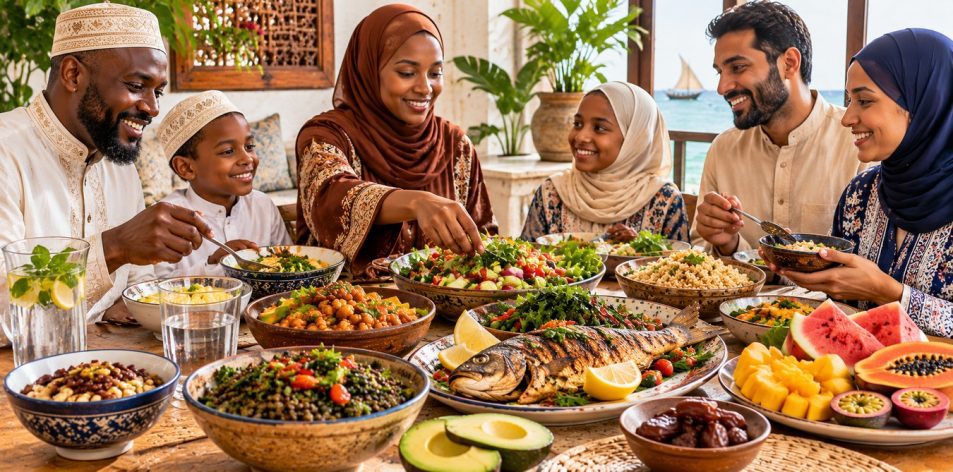
A nutritious diet does not need pork or pork-derived products. East Africa has a rich range of ingredients that can form the basis of balanced, satisfying meals.
Families can include:
- Fish and seafood: Fresh fish is widely available in coastal communities and can provide protein and beneficial fats.
- Halal chicken: A versatile protein source for family meals, provided it is sourced and prepared in accordance with halal requirements.
- Halal beef and goat meat: These can be included in balanced meals, with sensible portions and varied preparation methods.
- Beans, lentils and chickpeas: Affordable sources of plant protein and dietary fibre.
- Eggs and suitable dairy products: Useful sources of protein and other nutrients.
- Vegetables and traditional greens: Sukuma wiki, spinach, pumpkin leaves, carrots, tomatoes and other seasonal produce add fibre, vitamins and minerals.
- Fresh fruit: Mangoes, bananas, pawpaw, avocado, citrus fruits and other locally available produce contribute to a varied diet.
- Whole grains: Millet, sorghum, oats, wholemeal bread, brown rice and maize can provide energy and fibre.
Halal food and healthy food should be considered together. A product being halal does not automatically make it nutritionally balanced, just as a nutritious-looking product is not automatically halal. Reading labels, checking ingredients and choosing a variety of fresh foods are sensible habits.
What Should Muslim Families Teach Their Children About Pork?
Children may encounter different dietary habits at school, when travelling or when visiting friends. Parents can explain the prohibition of pork in a clear, positive and age-appropriate way.
They can teach children that Muslims avoid pork because Allah has prohibited it, and that the instruction is part of their faith. There is no need to frighten children with exaggerated claims that every pork product will cause illness.
Instead, families can explain that certain foods can carry health risks when contaminated or prepared improperly, and that good hygiene is important for everyone. Children can also learn to check food labels, recognise halal certification and ask politely about ingredients when eating outside the home.
Most importantly, children should understand that following halal dietary rules can be part of an enjoyable and varied way of eating. Fresh fruit, vegetables, fish, grains, legumes and properly sourced halal meat provide plenty of options for family meals.
Faith, Food And The Responsibility To Make Informed Choices
The prohibition of pork has a clear place in the teachings associated with Prophets Moses, Jesus and Muhammad (peace be upon them). The Torah explicitly identifies the pig as unclean and prohibits eating its flesh. Jesus lived within the first-century Jewish religious setting in which those dietary laws were widely observed, and the historical evidence supports the conclusion that he abstained from pork. The Qur’an then explicitly prohibits swine flesh and describes it as impure.
Modern health research has identified genuine risks associated with consuming raw, undercooked or contaminated pork, including tapeworm infection, cysticercosis, trichinellosis, toxoplasmosis, hepatitis E and bacterial foodborne illnesses. Research also establishes that regular consumption of processed meat increases the risk of colorectal cancer.
These findings are important, but they must be presented accurately. Not every pork product carries every infection, some diseases can be acquired through other routes, and the evidence concerning processed meat should not be confused with the evidence concerning unprocessed meat.
For Muslims, none of these scientific distinctions changes the religious ruling. Pork remains haram, whether it is raw, cooked, cured, smoked, frozen or prepared using modern food-safety methods.
Ultimately, a Muslim’s decision to avoid pork begins with obedience to Allah. Understanding the teachings of the prophets, recognising the health risks identified by medical research and choosing wholesome halal foods can help families make informed decisions with confidence. Faith provides the guidance, while knowledge helps us care responsibly for the health and wellbeing of those entrusted to us.