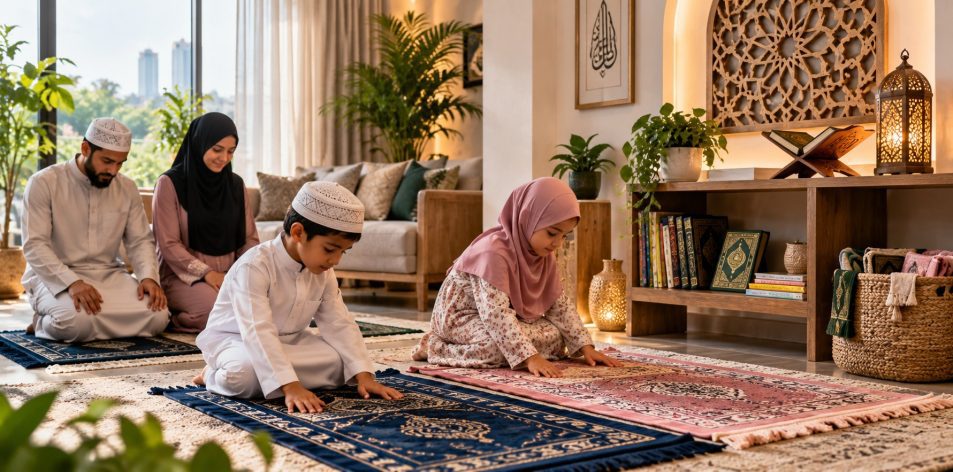
For many Muslim families, salah is one of the most important routines to establish at home. Yet with school, homework, work, meals, screen time and everything else that happens during a busy family day, prayer can sometimes become something that everyone intends to do but struggles to organise consistently.
One simple way to make salah a more natural part of family life is to create a dedicated prayer space at home.
A home prayer space does not need to be a separate room or an expensive renovation. It can simply be a clean, comfortable and peaceful corner where family members know that they can pray, read Qur’an, make dhikr and take a few quiet moments away from the distractions of everyday life.
For children in particular, having a dedicated salah space can help make prayer feel like a normal and meaningful part of the home environment rather than something associated only with being told to stop what they are doing.
Why A Dedicated Prayer Space Can Help Children
Children learn a great deal through what they see around them. When they regularly see their parents preparing for salah, spreading their prayer mats and making time for prayer, they begin to understand that salah is not simply another task on a list. It is part of family life.
The Qur’an describes salah as being established for the remembrance of Allah. Creating a peaceful environment for prayer can therefore help reinforce the importance of making space for that remembrance within the home.
A dedicated prayer area also gives children a physical place associated with salah. Over time, the sight of their prayer mat, Qur’an, prayer clothing or other appropriate items can become a familiar reminder that it is time to pray.
It is not the décor itself that creates consistency. The real objective is to make the home environment supportive of a routine that parents and children can practise together.
You Do Not Need A Separate Prayer Room
If your home has a spare room that can be used for prayer, that can be wonderful. However, most families do not need a dedicated room to create a meaningful prayer space.
A quiet corner of the living room, bedroom, study or landing area can work perfectly well.
The important considerations are that the area is clean, reasonably quiet, free from unnecessary clutter and large enough for the people who will use it.
In a smaller home, a foldable prayer mat and a small storage basket can be enough. The prayer space can be opened when needed and neatly packed away afterwards.
The goal is not to create an impressive room for photographs. It is to create an environment that makes salah easier to practise consistently.
Choose A Calm And Practical Location
When choosing where to create your prayer space at home, think about how your family actually lives.
A beautiful corner that nobody uses is less useful than a simple area that the family naturally passes every day.
Consider a location where:
- There is enough room to place prayer mats comfortably.
- The floor can be kept clean.
- There is reasonable privacy when needed.
- Children can access their prayer items independently.
- The area is away from television and other major distractions.
- There is sufficient natural or warm artificial lighting.
- The prayer direction can be established clearly.
If possible, avoid placing the prayer area directly beside an area where people are constantly walking through, playing or storing household items.
A little separation from the busiest parts of the house can make the space feel more intentional.
Give Children Their Own Prayer Mats
One of the easiest ways to make a children’s prayer space inviting is to give each child their own prayer mat.
Allowing children to choose a suitable mat in a colour or pattern they like can give them a sense of ownership. It also makes the prayer routine more personal.
For younger children, consider keeping the mats somewhere they can easily reach rather than expecting an adult to prepare everything for them.
A low shelf, basket or dedicated drawer can hold prayer mats, lightweight prayer garments and other appropriate items.
As children grow older, encouraging them to take responsibility for keeping their prayer space tidy can become part of the routine itself.
Keep The Décor Simple
A prayer space does not need to look elaborate.
Natural materials, soft lighting, neutral colours, plants, wooden furniture and tasteful Islamic geometric patterns can create a calm environment without making the area feel overly formal.
For families who enjoy Islamic art, geometric patterns, tasteful calligraphy or other appropriate decorative elements can add character to the space.
However, avoid allowing decoration to become the main focus. A prayer space should remain functional and peaceful rather than becoming so heavily decorated that it creates visual distractions.
Create A Small Prayer Station For Children
A small prayer station can make a big difference, particularly for younger children.
You could have a low shelf or basket containing:
- Children’s prayer mats.
- Prayer clothing where appropriate.
- A Qur’an or age-appropriate Qur’an learning materials.
- Islamic children’s books.
- Simple prayer-learning resources.
- A small storage box for personal prayer items.
Keep the arrangement simple enough that children can take what they need and put it back without assistance.
This teaches an important lesson alongside salah: taking responsibility for one’s own worship environment.
Make The Space Child-Friendly Without Making Salah A Game
There is an important balance to maintain.
Children should feel welcome and comfortable in the prayer space, but the area should still communicate that salah is an act of worship.
That means choosing cheerful but appropriate décor rather than turning the prayer corner into a play area.
You can make it inviting through colour, comfortable storage, attractive prayer mats, books and thoughtful design without filling it with toys and unrelated distractions.
The atmosphere should communicate something simple: this is a special place where our family remembers Allah.
Let Children See You Using The Space
One of the most powerful ways to help children develop a consistent salah routine is to let them see the adults in the household taking salah seriously.
Children notice routines. They notice when parents stop what they are doing to pray. They notice when prayer is prioritised even on busy days. They notice whether adults treat salah as an inconvenience or as an important part of life.
This does not mean parents need to create a perfect household where nobody ever misses a routine or becomes distracted. It simply means that children should regularly see prayer being treated as something important.
A dedicated prayer space makes that visible.
Use The Prayer Space To Build A Routine
The space itself will not create a consistent salah routine. The family routine has to support it.
For example, when a prayer time arrives, children can be encouraged to finish what they are doing, prepare themselves and come to the prayer area.
For younger children, parents can use simple reminders rather than repeatedly shouting instructions from another room.
Over time, the sequence can become familiar:
- Prayer time arrives.
- The child finishes or pauses their current activity.
- They prepare for salah.
- They collect their prayer mat.
- They come to the family prayer space.
- They pray with the family when appropriate.
- They return their prayer items neatly.
Repeated routines can make the process much more natural.
Make It Easy To Pray Together
Where appropriate, a family prayer space can also make it easier for parents and children to pray together.
Children often enjoy being included rather than simply being told what they should do.
When they see parents preparing for salah, they can prepare alongside them. When the family prays together, the child experiences salah as something shared within the household.
For older children, parents can gradually encourage greater independence while continuing to provide reminders, encouragement and support.
Do Not Turn The Prayer Space Into A Place Of Constant Correction
This is particularly important when teaching young children.
A child who is still learning may make mistakes. Their movements may not be perfect. They may forget parts of the prayer. They may become distracted. They may need repeated teaching.
Parents should correct them appropriately while also remembering that children are learning.
If every visit to the prayer space results in criticism, the child may begin to associate the space with anxiety rather than worship.
Teach, correct, encourage and demonstrate.
The objective is to help the child grow into a person who understands the value of salah, not simply someone who is afraid of being reprimanded for making a mistake.
Encourage Children To Keep The Space Tidy
Responsibility can become part of the prayer routine.
Teach children that prayer mats should be folded or stored appropriately, books should be treated respectfully and the area should remain clean.
These small habits can help children understand that worship involves preparation and respect.
It also means the next prayer is easier because everything is already organised.
Consider A Small Qur’an And Reading Corner
If you have enough space, the prayer area can include a small reading corner.
A low shelf can hold Qur’ans, children’s Islamic books and age-appropriate learning materials. A comfortable cushion or small chair can give children a place to sit and read.
This can help connect salah with a wider culture of remembrance, learning and reflection within the home.
Keep Qur’ans and other religious materials stored respectfully and make sure the area remains clean and well maintained.
Use Lighting To Create A Peaceful Atmosphere
Lighting has a surprisingly significant effect on how a room feels.
During the day, natural light can make a prayer space feel fresh and open. In the evening, warm and gentle lighting can create a quieter atmosphere.
A simple floor or table lamp positioned away from the prayer area may be enough. Avoid overly bright or distracting lighting, particularly if the space is also used for Qur’an reading.
Think About Storage From The Beginning
One of the biggest practical mistakes when designing a prayer corner is creating a beautiful area without considering where everything will be stored.
Prayer mats can quickly end up folded over sofas or left on the floor if there is no designated storage.
Consider:
- A woven basket for prayer mats.
- A small wooden cabinet.
- A low shelf for children’s items.
- Wall-mounted storage where appropriate.
- A drawer within an existing console or cabinet.
The simpler the storage system, the more likely children are to use it independently.
Keep Screens Away From The Prayer Area
If possible, keep televisions, gaming consoles and other major entertainment devices away from the dedicated prayer space.
Modern homes already contain enough distractions. The prayer area can provide a useful contrast.
When children enter the space, the expectation changes. They are stepping away from entertainment and into a moment of worship and concentration.
This does not require strict rules about every device in the house. It simply means designing the space so that distractions are reduced.
Make Salah Part Of The Family Culture
A prayer corner works best when it becomes part of a broader family culture of salah.
Children should hear parents speaking positively about prayer. They should see adults making time for it. They should understand that salah is not something reserved for the mosque or for religious occasions.
It is part of everyday Muslim life.
The Qur’an reminds believers to protect themselves and their families, a responsibility that includes guiding the household towards obedience and good practice. A home environment that supports salah can be one practical expression of that responsibility.
Do Not Expect Perfection Overnight
Building a consistent salah routine takes time, particularly with young children.
There will be mornings when everyone is rushing. There will be evenings when homework takes longer than expected. There will be days when children are tired, distracted or simply resistant.
Do not allow an imperfect day to become an excuse to abandon the routine.
Start again at the next prayer.
Consistency is built through repeatedly returning to the routine, not through expecting perfection every single day.
Let The Space Grow With Your Children
A prayer space that works for a five-year-old may not suit a twelve-year-old.
As children grow, update the space accordingly.
You might replace children’s prayer mats with larger ones, introduce a more mature storage system, add books appropriate to their age or create more personal space for Qur’an study.
The important thing is that the prayer space remains relevant to the family rather than becoming something that belongs to an earlier stage of childhood.
Remember That The Space Is A Means, Not The Goal
It is easy to become focused on interior design and forget the reason for creating the space in the first place.
You do not need expensive prayer mats, custom cabinetry, designer furniture or a large room.
A clean corner, a few prayer mats and a family committed to making time for salah can be more meaningful than an elaborate prayer room that nobody uses.
The purpose is to remove unnecessary obstacles and make prayer feel naturally integrated into the home.
A Simple Checklist For Creating A Home Prayer Space
If you are starting from scratch, keep it simple.
- Choose a clean and relatively quiet area.
- Establish the direction of the Qiblah.
- Provide comfortable prayer mats.
- Give children easy access to their own prayer items.
- Add simple and appropriate Islamic décor if desired.
- Create practical storage.
- Keep major entertainment distractions away.
- Provide suitable lighting.
- Keep Qur’ans and religious materials respectfully stored.
- Use the space regularly.
- Let children see adults using it.
- Encourage children without making every prayer a source of criticism.
- Adapt the space as children grow.
Creating A Home Where Salah Belongs
A dedicated prayer space at home may seem like a small interior design decision, but it can become part of a much bigger family routine.
For children, seeing a prayer mat waiting in the same peaceful corner each day can provide a simple visual reminder of salah. Watching parents use that space can reinforce the importance of prayer. Having their own prayer mat and being given responsibility for their belongings can help them develop a sense of ownership.
Most importantly, the prayer space should support a home environment in which salah is valued, practised and treated as a natural part of Muslim family life.
As parents, we cannot control exactly how our children will develop as they grow. But we can provide an example, establish good routines, teach them patiently and create an environment that makes it easier for them to remember Allah.
Sometimes that begins with something as simple as clearing a quiet corner, laying down a prayer mat and making room in the home for salah.