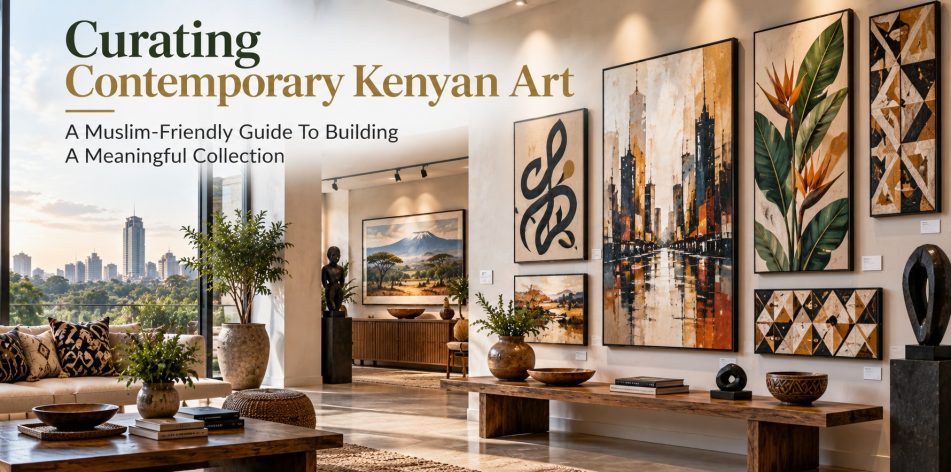
How To Build A Beautiful, Meaningful Collection That Celebrates Kenya While Reflecting Your Values
Art can transform a home, office or hospitality space. The right collection can add character, create conversation and tell a story about the people, places and cultures that matter to you.
For a Muslim collector, however, there may be another consideration: how can you enjoy contemporary Kenyan art while ensuring that the pieces you bring into your home are compatible with your personal understanding of Islamic aesthetics and values?
The answer does not have to be choosing between contemporary Kenyan art and Islamic-inspired design.
Kenya has a vibrant contemporary art scene, with artists working across painting, sculpture, photography, mixed media, printmaking, textiles and other forms. Organisations such as Kuona Trust have supported contemporary visual artists through studios, exhibitions, training, mentoring and other programmes, while galleries such as Circle Art Gallery continue to provide platforms for both established and emerging artists.
This creates an exciting opportunity for Muslim collectors: you can build a collection that is unmistakably Kenyan, contemporary and personal while selecting works that sit comfortably with your aesthetic principles.
Start By Understanding What Islamic Aesthetics Mean To You
There is no single style of “Islamic art” that applies to every Muslim community or every period of history.
Islamic artistic traditions have developed across many countries and centuries, incorporating different regional cultures, materials and artistic approaches.
However, several visual elements are strongly associated with Islamic artistic traditions, including geometric patterns, calligraphy and vegetal or botanical decoration.
These can provide an excellent starting point when curating a contemporary collection.
Look Beyond Traditional Islamic Art
You do not need to fill your home with traditional Islamic paintings, mosque-inspired decoration or reproductions of historic designs.
Contemporary Kenyan artists can interpret ideas such as geometry, nature, repetition, balance, architecture, landscape and abstraction in completely modern ways.
For example, a Kenyan abstract painting using repeated geometric forms may complement an interior influenced by Islamic design without being explicitly religious.
Likewise, a contemporary work inspired by leaves, trees, flowers, water or the Kenyan landscape can bring a natural quality into a room while maintaining a restrained and sophisticated aesthetic.
Geometry Can Be A Powerful Starting Point
Geometric design has a long history in Islamic art. The Metropolitan Museum of Art identifies geometric patterns, calligraphy and vegetal patterns among important non-figural forms associated with Islamic artistic traditions.
Contemporary collectors can interpret this principle in many ways.
Look for:
- Repetition
- Symmetry
- Interlocking forms
- Circles and polygons
- Star patterns
- Structured grids
- Abstract line work
- Balanced compositions
The beauty of geometric art is that it can feel distinctly contemporary while still connecting visually with a much older artistic tradition.
Consider Contemporary Kenyan Artists Working With Pattern
One of the most interesting approaches is to look for Kenyan artists who use pattern, texture, repetition or abstraction in their work.
The work does not need to contain recognisably Islamic motifs. Instead, consider whether its visual language works harmoniously with the principles you want your collection to express.
This allows you to support Kenyan creativity without asking an artist to imitate another culture’s traditional art.
Calligraphy Can Add A Strong Visual Element
Calligraphy has a particularly important place within Islamic artistic traditions, where writing can become an artistic element in its own right.
Arabic calligraphy can therefore be incorporated into a collection, but it should be selected thoughtfully.
If you are considering Qur’anic verses or other sacred text, think carefully about where the work will be displayed and how it will be treated. Sacred words should not simply be used as decorative filler.
You may also choose contemporary calligraphy that uses Arabic lettering as an artistic language without necessarily displaying Qur’anic text.
This can create a sophisticated connection between contemporary art and Islamic visual culture while avoiding the risk of treating sacred text casually.
Be Careful With Figurative Art If It Conflicts With Your Personal Practice
One area where Muslim approaches can differ is figurative representation.
Islamic artistic history includes extensive examples of figurative imagery, particularly in certain secular manuscripts, objects and regional traditions, while other Muslim traditions have placed greater emphasis on non-figurative expression.
For this reason, there is no need to pretend that every Muslim collector has exactly the same view.
If your personal or scholarly understanding of Islamic practice leads you to avoid representations of people or animals, you can build an impressive collection without them.
Abstract art, landscapes, architecture, botanical works, geometric compositions, calligraphy, textures and non-figurative sculpture can provide enormous variety.
Kenyan Landscapes Can Become A Major Theme
One of the easiest ways to connect a contemporary collection to Kenya is through landscape.
Kenya offers extraordinary visual possibilities: the Great Rift Valley, Mount Kenya, the coast, forests, lakes, farmland, urban skylines, dry landscapes and changing skies.
A contemporary interpretation of a Kenyan landscape can bring a strong sense of place into your home without requiring figurative imagery.
Instead of buying generic decorative art, consider building a collection around places that have personal meaning to you.
Think About Architecture
Architecture provides another excellent subject for a Muslim-friendly contemporary collection.
Kenya’s architectural landscape includes old coastal buildings, Swahili architecture, contemporary Nairobi developments, historic town centres, mosques, homes, markets and public spaces.
Doors, windows, arches, courtyards, shadows, textures and repeating architectural details can all become powerful subjects for contemporary artists.
This can also create an interesting bridge between Kenyan heritage and Islamic visual influences, particularly when exploring the architectural traditions of the Kenyan coast.
Explore Botanical And Nature-Inspired Works
Vegetal decoration has a long association with Islamic art, and contemporary Kenyan artists have an enormous natural world from which to draw inspiration.
Consider works inspired by:
- Indigenous trees
- Tropical leaves
- Flowers
- Seeds
- Grasses
- Mountains
- Water
- Gardens
- Natural textures
Such pieces can introduce colour and life into an interior without overwhelming the overall design.
Do Not Confuse Islamic Aesthetics With Simply Using Gold And Green
Gold, green, blue and earth tones can work beautifully in interiors influenced by Islamic design, but colour alone does not make something Islamic.
Good curation is about composition, balance, material, proportion, repetition and meaning.
A restrained black-and-white geometric artwork can sit beautifully alongside contemporary Kenyan furniture, while an earthy landscape can complement natural wood and stone.
Think about the overall visual language rather than trying to make every object look traditionally Islamic.
Let Kenyan Identity Remain At The Centre
If your goal is to support emerging Kenyan artists, do not turn your collection into a collection of imported “Islamic-style” decorations simply because you want an Islamic aesthetic.
Instead, look for Kenyan artists whose work naturally complements your values.
The result can be much more interesting: Kenyan contemporary art viewed through the personal lens of a Muslim collector.
Your collection might include abstract works, Kenyan landscapes, architectural studies, geometric compositions, botanical pieces, textile art and contemporary calligraphy.
It can be proudly Kenyan without becoming a reproduction of another artistic tradition.
Buy From Emerging Artists
One of the most rewarding ways to build a collection is to discover artists before they become widely established.
Emerging artists often produce excellent work at prices that are more accessible than those of internationally established names.
More importantly, your purchase can provide meaningful support at an important stage of an artist’s career.
Kenya has organisations and galleries that actively create opportunities for emerging artists. Kuona Trust, for example, describes its work as supporting contemporary visual artists through studios, exhibitions, training, mentoring and other programmes. Circle Art Gallery has also run Artists Open Week initiatives that provide emerging artists with portfolio reviews, career advice and exhibition opportunities.
Visit Studios And Exhibitions
Do not limit yourself to online shopping.
Visit exhibitions, galleries, artist studios and creative spaces when possible.
Seeing an artwork in person can completely change your perception of it.
You can see the texture of the paint, the quality of the materials, the scale of the work and how the artist has constructed it.
You can also speak with artists and learn about their inspiration.
That knowledge can make owning the work considerably more meaningful.
Ask The Artist About The Story Behind The Work
Before buying an emerging artist’s work, ask questions.
What inspired the piece?
What materials were used?
What does the artist want the viewer to notice?
Is the work part of a larger series?
How was it made?
What does the artist think about the relationship between the work and Kenyan society or culture?
These conversations can help you decide whether the artwork belongs in your collection for reasons beyond simply matching your sofa.
Do Not Buy Art Only Because It Matches Your Interior
A collection should have some personality.
It is perfectly reasonable to consider whether a painting works with your interior, but do not make colour matching the only criterion.
You may eventually move house, repaint a room or change your furniture.
A meaningful artwork should continue to interest you even when the surrounding décor changes.
Ask yourself whether you would still want the piece if you saw it in a completely different room.
Build A Collection Around Themes
Instead of buying random pieces, consider creating a theme.
Your collection could focus on:
- Kenyan landscapes
- Nairobi architecture
- Swahili coastal heritage
- Geometric abstraction
- Nature and botanical forms
- Contemporary Kenyan textiles
- Calligraphy and lettering
- Earth, clay and natural materials
- Kenyan urban life interpreted through abstraction
A theme does not mean every piece needs to look identical. The theme simply provides a thread connecting the collection.
Mix Established And Emerging Artists
You do not have to choose between established artists and newcomers.
A strong collection can include both.
An established Kenyan artist may provide a significant anchor piece, while works by younger artists can introduce new ideas and perspectives.
This also allows collectors to support emerging talent while learning more about the broader Kenyan contemporary art scene.
Consider Different Media
A collection does not need to consist entirely of paintings.
Consider:
- Prints
- Photography
- Textiles
- Ceramics
- Woodwork
- Metalwork
- Contemporary sculpture
- Mixed-media pieces
- Works on paper
- Handcrafted objects
Different materials can create depth and interest throughout a home.
They can also provide opportunities to support artists who work outside traditional painting.
Be Mindful About Where You Display Sacred Text
If your collection includes Qur’anic calligraphy or other sacred Islamic text, give the work an appropriate place in the home.
It should be displayed respectfully rather than treated like an ordinary decorative object.
Consider the room, height, surrounding objects and overall environment before deciding where to place it.
For collectors who prefer to keep sacred text separate from purely decorative art, contemporary Arabic calligraphy without Qur’anic verses can provide another option.
Think About The Atmosphere Of The Room
Art can affect the atmosphere of a space.
A calm abstract work with restrained colours can create a very different feeling from a large, highly energetic composition.
For a Muslim home, you may want spaces that feel peaceful, balanced and welcoming.
This does not mean that every piece needs to be quiet or minimalist. It simply means that the collection should contribute positively to the character of the home.
Quality Matters More Than Quantity
You do not need twenty paintings to have a serious collection.
Five carefully selected pieces that you genuinely appreciate can be more meaningful than a wall filled with artwork purchased without much thought.
Give each piece room to breathe.
Consider scale, spacing and lighting. A smaller work can sometimes have more impact when it is given sufficient space around it.
Document Your Collection
Once you begin collecting, maintain a record of your artworks.
Keep information such as:
- Artist’s name
- Title of the work
- Year created
- Medium
- Dimensions
- Purchase date
- Purchase price
- Certificate of authenticity, where applicable
- Gallery or artist details
- Photographs of the artwork
This information becomes increasingly valuable as your collection grows.
Buy Directly When Appropriate
Buying directly from an artist can be a rewarding way to support emerging talent.
However, galleries and professional art organisations also play an important role in developing the art ecosystem.
Do not assume that buying directly is always better or that buying through a gallery is simply more expensive. Galleries can provide professional curation, authentication, exhibition opportunities, artist support and market access.
Where possible, understand who you are buying from and how your purchase supports the artist.
Do Your Due Diligence
Even when you love an artwork, take a little time before making a significant purchase.
Research the artist. Look at their previous work. Check whether the gallery or seller is reputable. Ask about provenance and authenticity where appropriate.
For higher-value purchases, consider obtaining proper documentation and professional advice.
Collecting art should be enjoyable, but responsible collecting also means knowing what you are buying.
You Can Support Artists Without Compromising Your Values
One of the most positive aspects of collecting contemporary Kenyan art is that your purchase can do more than decorate your home.
You can help an artist purchase materials, develop a new body of work, participate in an exhibition or continue pursuing a professional artistic career.
At the same time, you can remain selective about what enters your home.
You do not have to purchase every artwork you admire. Appreciate an artist’s talent while recognising that a particular piece may not be suitable for your personal values or home.
A Practical Checklist For Muslim Art Collectors
Before purchasing a piece, ask yourself:
- Do I genuinely like the artwork?
- Does it represent or connect with Kenyan culture, place or creativity?
- Does the subject matter fit my personal Islamic values?
- Am I comfortable with any figurative elements?
- If it contains Arabic or sacred text, will I display it respectfully?
- Do I understand who created the work?
- Am I buying from a reputable artist, gallery or seller?
- Does the price make sense for my budget?
- Can I properly care for and display the artwork?
- Will I still appreciate this piece years from now?
Build A Collection With Meaning
A contemporary Kenyan art collection does not need to be expensive, enormous or heavily formal.
It can begin with one piece by a young artist whose work speaks to you.
Over time, you can add pieces that explore Kenya’s landscapes, architecture, culture, nature, geometry, materials and contemporary identity.
For a Muslim collector, Islamic aesthetic principles can provide another layer of thoughtfulness through an appreciation of balance, abstraction, geometry, calligraphy, natural forms and respectful presentation.
The most important thing is not to force Kenyan art into a narrow definition of what Islamic art should look like. Instead, allow Kenyan artists to remain themselves while you curate a collection that reflects your own taste, values and connection to the country.
That is what makes collecting meaningful.
You are not simply decorating a room. You are supporting creativity, preserving stories, celebrating Kenyan talent and creating a visual environment that reflects who you are.