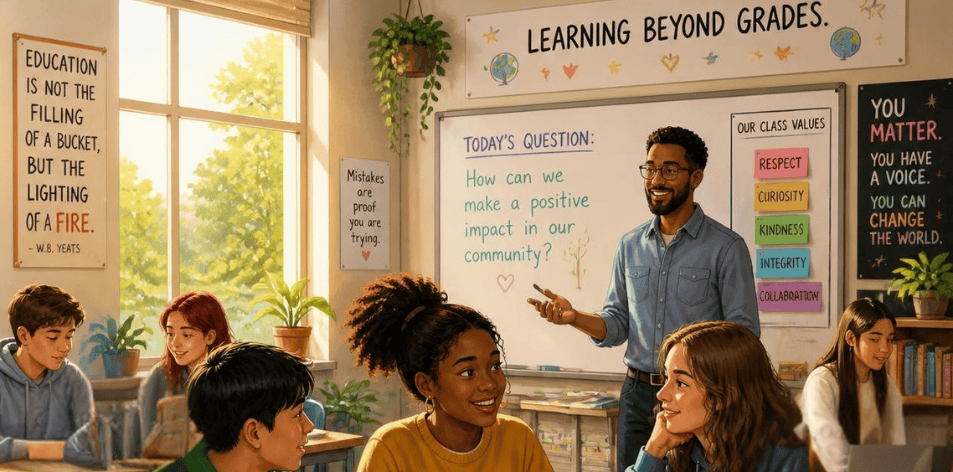
Why Education Is More Than Grades
For many children, education can feel like a journey measured by marks, examinations and report cards.
Academic performance is important. Grades can reflect effort, knowledge and progress, and they can help children move towards future educational opportunities. But a report card can never tell the complete story of a child’s development.
Education should prepare children not only to perform well, but also to think well, live responsibly and understand their purpose.
The Limits of Academic Scores
A grade measures performance in a particular assessment. It does not necessarily measure curiosity, creativity, character, resilience or a child’s ability to apply knowledge in everyday life.
Two children can receive similar marks while having very different strengths and learning experiences.
When children begin to believe that their grades determine their worth, academic pressure can become unhealthy. A disappointing result may feel like a personal failure rather than an opportunity to identify what needs improvement.
Parents can help children understand that a grade is information about performance, not a definition of who they are.
Teach Children Why They Are Learning
Children often engage more deeply when they understand the purpose behind what they are being taught.
Mathematics can develop problem-solving and logical thinking. Science can encourage curiosity. History can help children understand society and the consequences of decisions. Literature can develop imagination and empathy.
Instead of focusing only on what children need to memorise for an examination, parents can ask questions such as:
“What did you discover?”
“Why do you think this matters?”
“How could you use what you learned?”
These simple conversations can transform learning from an obligation into something meaningful.
Recognise Effort and Improvement
Achievement is not always about receiving the highest mark.
A child who improves from one examination to the next has achieved something. A child who continues working after finding a subject difficult is developing perseverance. A child who asks questions is demonstrating curiosity.
Parents can encourage this by recognising:
✔️ Effort and commitment
✔️ Improvement over time
✔️ Curiosity and questioning
✔️ Persistence when something is difficult
✔️ Willingness to learn from mistakes
When children understand that progress matters, they become less afraid of the learning process.
Let Children Learn From Failure
Children will not always succeed, and they should not be expected to.
A mistake can teach a child how to approach a problem differently. A disappointing result can reveal where additional effort is needed. A difficult project can teach patience and adaptability.
Rather than immediately focusing on what went wrong, parents can ask:
“What did you learn from this?”
“What could you do differently next time?”
This teaches children that failure does not have to be the end of the journey.
Education Should Build Character
Knowledge is valuable, but how children use that knowledge matters just as much.
Education should help children develop honesty, responsibility, respect, empathy and good judgement.
A child may achieve excellent academic results, but education is incomplete if they have not also learned how to treat others, accept responsibility and make thoughtful decisions.
True education develops both competence and character.
Preparing Children For Life, Not Just Exams
Examinations eventually end, but life continues to present new questions and challenges.
As adults, children will need to make decisions without having every answer provided to them. They will encounter disagreements, disappointments, unexpected changes and situations that cannot simply be solved by remembering something from a textbook.
They will need judgement, communication, adaptability and resilience.
This is why children should be encouraged to think critically, solve problems independently and understand the consequences of their choices.
Give Children Room to Discover Their Strengths
Not every child will excel in the same subjects or in the same way.
One child may love mathematics, while another may discover a passion for art, technology, business, sport or working with people.
Parents should encourage children to work hard academically while also giving them opportunities to explore their interests and discover their strengths.
Purpose is often discovered through exploration rather than imposed through expectation.
Education and Islamic Values
For Muslim families, education can also be connected to the broader values of seeking beneficial knowledge and developing good character.
Knowledge should not simply be viewed as a pathway to personal achievement. It can be used to serve others, contribute to society and fulfil responsibilities with integrity.
Children can therefore be encouraged to ask not only, “What can I achieve?” but also, “How can I use what I learn to benefit others?”
This helps children understand that education can have a purpose beyond qualifications and personal success.
Redefining Success
Parents naturally want their children to succeed, but success does not have to mean achieving the highest marks in every subject.
It can also mean becoming more confident, developing discipline, learning from mistakes, becoming responsible and discovering a genuine love of learning.
Instead of always asking, “What grade did you get?”, parents can also ask:
✔️ What did you learn today?
✔️ What was difficult?
✔️ What are you proud of?
✔️ What would you like to improve?
✔️ What did you discover that interested you?
These questions remind children that their education is about more than a number on a page.
Grades can measure academic performance, but they cannot measure the entirety of a child’s potential or character.
Grades may open doors, but purpose determines direction.
When education combines knowledge with character, curiosity, responsibility and purpose, children are better prepared not only to pass examinations, but to navigate life with confidence, wisdom and conscience.