
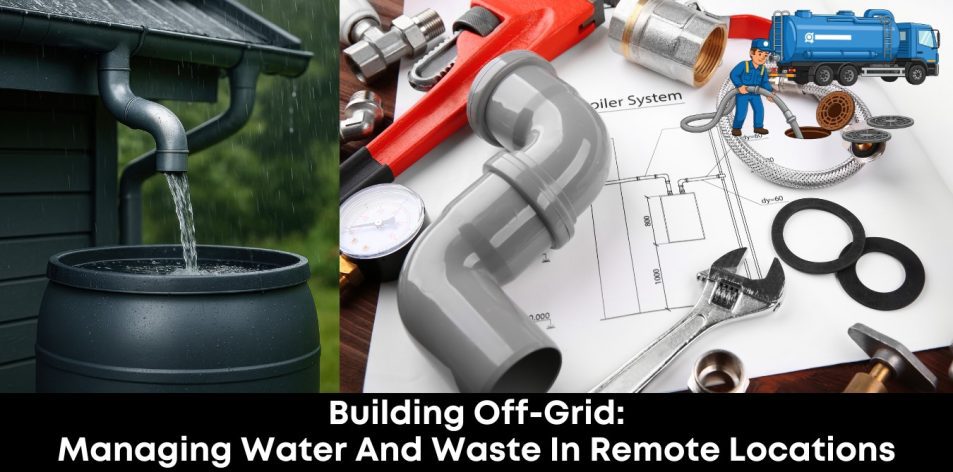
Practical Solutions for Independent Property Development
Developing a property in a remote or rural area offers a unique sense of peace and independence. However, being “off the grid” means you must take full responsibility for the essential services that are usually provided by the local government or municipal councils. When you do not have access to public water lines or a central sewage system, you must design your own self-sustaining infrastructure. By utilising modern technology and time-tested methods, you can create a property that is both comfortable and environmentally responsible. This article explores the best options for securing a water supply and managing waste on a remote property.
I. Securing a Reliable Water Supply
Water is the most critical resource for any household. In remote areas, you must look to the ground and the sky to meet your needs.
1. Sinking a Borehole
A borehole is often the most reliable long-term solution. By drilling deep into the earth to reach an aquifer, you can tap into a consistent supply of groundwater. In many parts of Kenya, borehole water is used for everything from drinking to irrigation.
- Consideration: Before drilling, you must hire a hydrogeologist to conduct a survey and obtain the necessary permits from the Water Resources Authority (WRA). You will also need a pump—often solar-powered in remote areas—and a storage tank.
2. Rainwater Harvesting Systems
In regions with decent rainfall, your roof can serve as a massive catchment area. By installing high-capacity gutters and large storage tanks, you can collect and store thousands of litres of soft, clean water.
- Consideration: To ensure the water is safe for domestic use, install a first-flush diverter to remove debris from the initial runoff and a filtration system for water used in the kitchen.
3. Water Trucking
If a borehole is not feasible and rain is scarce, you can have water delivered by bowsers (trucks). This requires large on-site storage tanks (either underground or elevated) to hold the delivered supply until the next refill.
II. Independent Sewage and Waste Management
Without a municipal sewer line, you must treat and dispose of wastewater on your own land in a way that is hygienic and odour-free.
1. Septic Tank Systems
The traditional septic tank is a buried, watertight container made of concrete or fibreglass. It holds waste long enough for solids to settle at the bottom and oils to float to the top. The liquid (effluent) then exits the tank into a “soak pit” or “drain field” where it is naturally filtered by the soil.
- Maintenance: Septic tanks are reliable but require occasional “exhausting” (emptying) by a professional service every few years depending on usage.
2. Biodigester Systems
A modern and increasingly popular alternative is the biodigester. This is a compact system that uses anaerobic bacteria to break down organic waste much faster than a standard septic tank. The process results in treated water that can often be recycled for garden irrigation and a small amount of odourless solid waste that can be used as compost.
- Benefit: Biodigesters take up much less space than a septic tank and rarely need to be emptied, making them ideal for remote properties with limited access for exhaustion trucks.
3. Constructed Wetlands
For those with ample land, a constructed wetland uses natural plants and gravel to filter “greywater” (from showers and sinks). This is an eco-friendly way to recycle water for your landscape while creating a beautiful garden feature.
III. Strategic Planning for Success
When building in the middle of nowhere, the layout of these systems is crucial. Ensure your septic system or soak pit is located a safe distance (usually at least 30 to 50 metres) away from your borehole to prevent any risk of cross-contamination. Additionally, utilise gravity by placing water tanks on high ground or towers to ensure a steady flow to your taps without relying entirely on electric pumps.
Building in a remote location requires careful foresight, but the result is a resilient and self-sufficient home. By choosing the right combination of water sourcing and waste treatment, you ensure that your property remains a sanctuary of comfort and cleanliness, no matter how far it is from the nearest town.